
Water Heater Replacement Cost in 2026: Every Line on the Quote, Explained
Ask what a new water heater costs and you get an answer about a box. What you sign is a project: the box, licensed labor, the permit, code-required parts, and disposal of the rusted cylinder it replaces. This hub follows the water heater replacement cost through all of it with national 2026 figures: which lines on a quote are normal, which are negotiable, and which are missing on purpose.
Leaking tank and no time to read? Check the table, then call (800) 555-0184; a licensed, insured installer near you puts an itemized number in writing, free.
Water heater replacement cost at a glance (2026 national data)
| System type | Typical installed cost (2026) | Average | Planning lifespan | Cost per year of service* |
|---|---|---|---|---|
| Storage tank, gas or electric | $881-$1,826 (full range $600-$2,500 by size) | ~$1,346 | 8-12 years | ~$112-$168 |
| Tankless (on-demand) | $1,400-$3,900; complete replacements commonly $2,500-$4,500 | no single average reported | ~20 years (DOE) | ~$70-$195 |
| Heat pump (hybrid) | $3,200-$4,700 (observed $2,800-$8,000) | ~$4,200 | 10-15 years | ~$280-$420 |
*Our arithmetic: installed cost divided by planning lifespan, ignoring energy use. Ranges: 2026 national data from Angi; tankless lifespan: Department of Energy; 8-12 and 10-15 years are industry planning numbers (DOE credits a well-maintained tank with roughly 10-15).
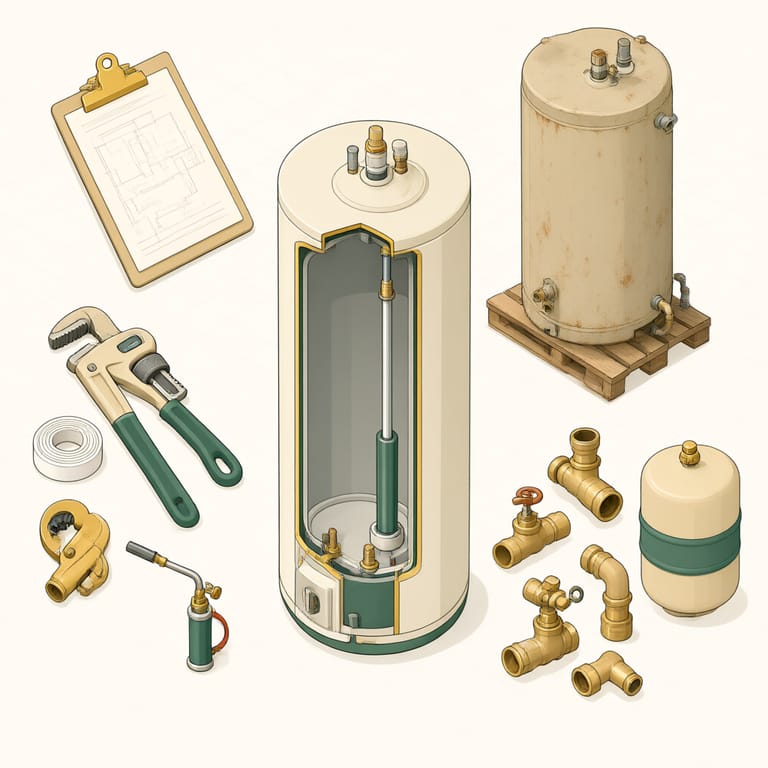
What is the average water heater replacement cost, and why the average misleads
The number most people hunt for is the $1,346 national average cost of replacing a tank water heater (Angi, 2026). Fair start, poor finish: it blends a 40-gallon electric tank in an open garage with a power-vent gas unit in a finished closet. The useful answer is a lane plus adjustments: fuel, size, location, inspector requirements, urgency.
Anatomy of a replacement quote: the five buckets
1. The unit. The only line most people research; size, fuel, warranty length, and efficiency tier set it (longer-warranty tiers carry a heavier anode rod and better lining).
2. Labor. Can rival or exceed the unit price: draining, disconnecting, hauling, setting, connecting, testing, at licensed-trade rates; the labor cost guide takes it apart.
3. Code-required extras. Expansion tank, temperature-and-pressure relief discharge line, seismic strapping in some states, a drain pan over finished space, venting corrections on gas. Inspectors fail the job without them; suspiciously low quotes often omit this bucket.
4. Permit and inspection. Most jurisdictions want one, gas swaps almost always; the fee is set locally, and the permits guide explains what the permit costs.
5. Haul-away and disposal. Small line, real cost; spent tanks are heavy and curbside pickup refuses them.
The replacement service page shows how the buckets get assembled on swap day.
Replacement water heater cost by fuel: gas, electric, and the heat pump wildcard
Natural gas heats water in about 48% of U.S. homes, electricity in 46%; propane and oil split the remainder (EIA).
Gas tanks carry the higher replacement bill (venting) and, historically, the lower operating bill; electric tanks are the simplest, cheapest swap. Rates set the gap: EIA's May 2026 residential electricity average is 18.44 cents per kilowatt-hour, while residential gas in 2024 ran $15.34 for a thousand cubic feet (EIA), call it $1.48 a therm. Heating water takes about 18% of a typical home's energy (EIA).
Heat pump water heaters pull warmth from the air into the tank; ENERGY STAR rates certified models at up to four times the efficiency of a standard electric tank, about $550 a year for a family of four, which is how a $4,200 install beats a $1,346 one over its life. Tankless units save less: per DOE, 24-34% against a conventional tank in homes drawing about 41 gallons of hot water daily or fewer, 8-14% for heavy users.
A DOE rule taking effect May 6, 2029 requires heat pump technology in any new electric storage model above 35 gallons; a standard electric 50-gallon tank bought today is the last of its kind.
Fuel-specific numbers: the 50-gallon electric cost page and the tankless cost guide; the gas vs electric comparison runs the long-term math.
Cost to replace a water heater by size: 40, 50, and 75 gallons
Capacity moves the price less than people expect (40 to 50 gallons is a modest step); the full $600-$2,500 installed range Angi reports for tanks (2026) gets its spread from the ends. The 50 gallon water heater replacement cost is the figure most quotes are built around, because 50 gallons is the usual family default. The trap is the top end: 75-gallon and power-vent models cross into semi-commercial territory where unit and labor both climb.
Upsizing because hot water runs out? Price a fix first: a failed dip tube or sediment eating tank volume is a repair-priced problem; the repair-or-replace guide helps you tell.
50 gal gas: why it prices above electric
For a gas household this is the default job (quotes abbreviate it "50 gal gas"), and its replacement cost usually lands above the same-size electric water heater: flue connection, combustion-air clearances, and gas hookup add labor hours an electric swap skips. Like-for-like it sits in the $881-$1,826 tank lane (Angi, 2026); code catch-up, a vent change, or a tight closet pushes it out, not tank size.
Where the identical job gets more expensive
Same 50-gallon gas tank, two houses, quotes hundreds of dollars apart, both fair. What separates them:
Location of the heater. Garage with clear access is the baseline; attics, crawl spaces, and tight closets add hours, and an attic install needs a drain pan routed safely.
Vent type. An atmospheric-vent tank reuses the flue; power-vent and direct-vent models need a blower and a sealed vent run, a bigger job than the swap.
What the inspector will notice. If the last install predates current code, the swap triggers the catch-up, one honest reason a licensed quote looks padded beside a handyman's cash price.
When you call. A planned weekday install is the cheap version; a holiday-weekend failure rents the installer's urgency and narrows selection to what is stocked. Past the 8-12 year window, replace on your calendar, not the tank's.
Ready to talk to a licensed water heater pro?
Call (800) 555-0184Free call. A licensed local water heater installer picks up.Licensed water heater partners in your area- Licensed and insured partner network
- 24/7 call routing
- Free call, no obligation
- You approve the price with the installer directly
Which cost guide do you need? Pick by your situation
- Labor line bigger than the heater: the water heater installation labor cost guide.
- Tempted by tankless: the tankless water heater cost guide.
- 50-gallon electric tank: the 50-gallon electric water heater cost page.
- Not sure replacement is necessary: the water heater repair cost guide.
- Mid-life tank you want to stretch: the anode rod replacement cost page.
- Electric tank giving lukewarm or no hot water: the water heater element replacement cost guide.
- The decision itself: Repair or replace?
- Decided to replace: the service page for a full replacement.
- Quote mentions a permit: the water heater permits guide.
Repair prices, for comparison
What the alternative costs, per national 2026 repair data (Angi, HomeGuide):
| Repair | Typical cost, parts + labor |
|---|---|
| Water heater repair, overall range | $228-$1,017 (average ~$600; extremes $90-$1,775+) |
| Heating element replacement | $100-$350 |
| Thermostat replacement | $100-$350 |
| Anode rod replacement (pro) | $150-$350; the part alone is $20-$50 |
| Thermocouple (part) | $20-$30 plus labor |
| Gas control valve, complex leak repairs | $200-$750 |
The working rule: a repair bill on a tank past mid-life that climbs toward 50% of a comparable new install is money going backward. Full numbers are in the repair cost guide, with deep dives on element replacement cost and anode rod replacement cost, the rare $150-$350 job that can postpone a $1,346 one.
DIY or professional installation: what you actually save
Doing it yourself removes one bucket, labor; the unit, permit, code items, and hauling out a heavy old tank remain.
Never DIY: gas connections and venting (leak and carbon monoxide risk), 240V electrical work, and the temperature-and-pressure relief valve with its discharge line. A relief valve discharge line stays open at its end, never capped or plugged: ICC case records include storage tank explosions that began that way. The thermostat should end up at 120F, the CPSC's scald-prevention setting; because 120F does not kill Legionella, immunocompromised households should ask about storing hotter and tempering at the fixtures with a mixing valve (OSHA). The DIY replacement guide walks the rest of the job.
Rebates in 2026: check before you count on anything
The Section 25C tax credit, 30% of a heat pump water heater project up to $2,000, no longer applies to equipment put into service after December 31, 2025 (IRS); an installer whose 2026 math still leans on it is a red flag. What remains: state-run HEAR rebates (income-qualified, status varies by state) and utility rebates; verify locally before signing anything that assumes incentive money.
How to compare water heater quotes without getting played
Get every quote itemized against the five buckets, then ask:
- "Is a permit in this price, and who files for it?" Yes, and them; an installer floating an unpermitted job is shedding risk onto you.
- "Which code items are in this price?" Expansion tank, discharge line, strapping, pan, venting; "we'll see what the inspector says" means change orders later.
- "What warranty covers the tank, and what covers your labor?" Tank coverage comes from the manufacturer by tier; labor coverage is the installer's own promise, usually shorter.
- "Who hauls off the old tank?" Put haul-away in the written quote.
- "Is this the installed price or the starting price?" Ask what findings would raise it; a pro can name them.
Treat both outliers with suspicion: the quote far under the field usually skimped on code items or the permit; the one far over should point at the line explaining it. Never let a monthly financing figure stand in for the itemized total.
When to skip the research and call
- Water is coming from the tank body itself, not a fitting or the drain valve: a corroded tank is a replacement.
- You smell gas near the unit: leave the house without touching switches or flames; dial 911, then the gas utility, once outside.
- Soot, scorch marks, or a lazy yellow burner flame on a gas heater: a combustion and carbon monoxide question, not a price question.
- The relief valve keeps discharging hot water, or the breaker on an electric unit keeps tripping: a licensed pro first.
For everything else, the guides above get you to a fair number; for a real one, call (800) 555-0184; a licensed local installer puts an itemized number in front of you, free.
Ready to talk to a licensed water heater pro?
Call (800) 555-0184Free call. A licensed local water heater installer picks up.Licensed water heater partners in your area- Licensed and insured partner network
- 24/7 call routing
- Free call, no obligation
- You approve the price with the installer directly