
Tankless Water Heater Replacement Cost: the Swap, the Conversion, and the 20-Year Math
$1,400 and $4,500 are both honest tankless quotes, for two very different jobs. Picture two neighbors replacing water heaters with tankless units in the same month: one pays the first figure, the other the second, and both got fair deals. The first already owned a tankless unit and swapped it for a newer model on the existing gas line, venting, and wiring. The second converted from a 40-gallon tank, which meant a bigger gas line, new stainless venting, and an electrician. Almost everything about your tankless water heater replacement cost comes down to which of those two homeowners you are, so settle that before anyone quotes you.
Replacement costs in 2026, sorted by job
The national figures below are Embercrest's compilation of 2026 cost data published by Angi, checked August 2026. Each installed figure bundles the heater itself, the labor, and standard hookups.
| Scenario | 2026 installed range | What's inside |
|---|---|---|
| Typical tankless project | $1,400-$3,900 | Unit, labor, standard hookups |
| Complete replacement (common range) | $2,500-$4,500 | Whole-home unit with venting and code items |
| Tank-to-tankless conversion | Top of the ranges above | Gas line upsizing, new venting, electrical, condensate drain |
| Repairing the existing water heater instead | $228-$1,017 typical, about $600 average | Parts and labor, national repair range |
| Staying with a tank instead | $881-$1,826 typical, about $1,346 average | Standard tank replacement, for comparison |
Want the number narrowed to your house? Call (800) 555-0184. Embercrest connects you with a licensed local installer for a free quote, and you approve any work directly with the pro.
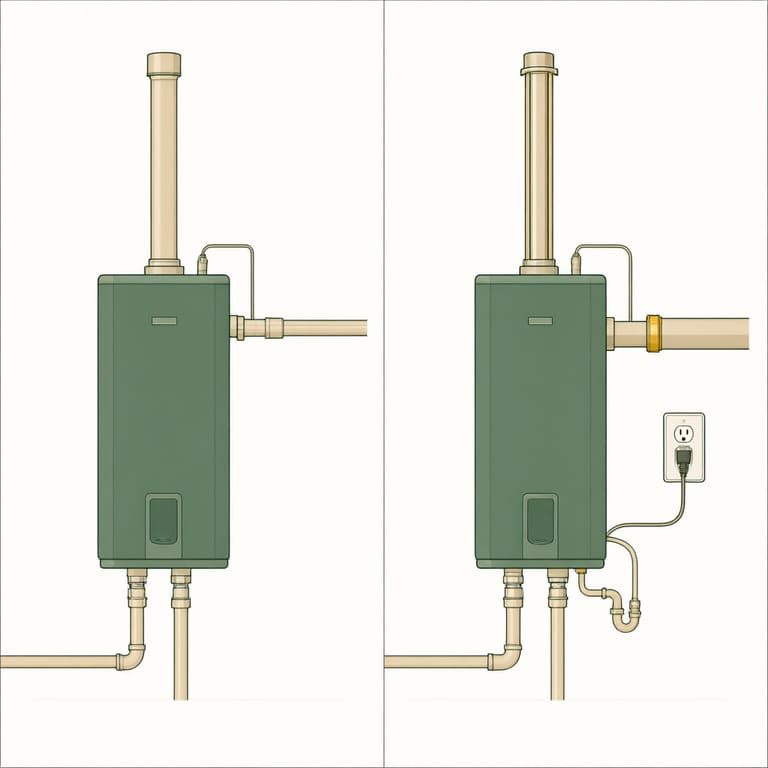
Swap or conversion: the fork that sets your price
A like-for-like swap (tankless replacing tankless) is the calm scenario. The gas line is already sized, the venting exists, the wall bracket is there. These jobs cluster near the bottom of the $1,400-$3,900 band, and the main variables are capacity and brand tier.
A first-time conversion is a small construction project. A tankless burner pulls several times the gas the old tank did, so the supply line frequently has to be upsized back to the meter. Combustion gases need dedicated stainless or PVC venting on a route your house was not built with. Condensing models need a drain. And the ignition and controls need an outlet where your old tank needed nothing. Those four items are why conversions sit at the top of the range, in the $2,500-$4,500 territory; a conversion bid suspiciously close to a swap price is usually missing one of them. Our tankless vs tank cost comparison runs the two paths side by side.
What else moves a tankless water heater replacement cost
Inside either scenario, these levers push the number:
- Flow rating (gallons per minute). A water heater sized for two showers and a dishwasher at once costs more than one sized for a single bathroom, and the bigger burner is often what forces the gas line upgrade. Up, sometimes sharply.
- Condensing or non-condensing. Condensing units carry a higher sticker price but wring more heat from the same gas and can vent in cheaper PVC, provided a condensate drain is nearby. Net effect depends on your vent route.
- Vent length and route. Every foot of stainless vent and every elbow is money. A short run through an exterior wall is the cheap case.
- Location. Keeping the unit where the old water heater stood is cheapest. Moving it adds gas, water, and vent runs.
- Water hardness. In mineral-heavy areas installers often quote a scale filter or softener alongside the unit. A real cost, and a real protection.
- Timing. Same-day and weekend scheduling carries a premium with many contractors; a conversion is a planned job.
Hidden costs: permit, disposal, and the code extras
Quotes that skip these grow later. Ask about each by name.
- Permit and inspection. Nearly every jurisdiction wants a plumbing permit for a tankless install, many add a gas or electrical permit, fees are set locally, and an unpermitted conversion has a way of surfacing at resale. Our water heater permit guide explains the process.
- Haul-away. A 40-gallon steel tank does not go out with the trash; disposal is a line item or a favor, so ask.
- Relief valve discharge. Tankless heaters are not exempt: IRC P2804.6.1, as the International Code Council summarizes it, wants the relief valve's discharge line at full valve diameter, ending where a drip would be noticed, and never capped. Bringing an old line up to that is a small but real item.
- Condensate neutralizer and drain. Condensate from a condensing unit is acidic, so installers usually put a neutralizer cartridge between heater and drain, and a drain has to exist to begin with.
- Other local code items. A thermal expansion tank on a closed system, seismic bracing, a drain pan over finished space, where your inspector requires them.
- Isolation valves with service ports. Not a code item, but the extra that turns every future descaling flush into a hookup job.
How much does it cost to install an on-demand water heater?
Installation is not a separate bill. The installed ranges above already include labor: $1,400-$3,900 for most projects and $2,500-$4,500 for a complete install (Angi, 2026). The labor share is what swings between a swap and a conversion. "On-demand" and "tankless" name the same product, a water heater that fires only when a tap opens. A complete install quote should itemize:
- The unit, by model and flow rating, plus the warranty term.
- Gas line work with the pipe size, or for electric, new circuits and any panel work.
- Vent kit and route: stainless or PVC, length, terminations.
- Condensate drain and neutralizer for condensing models.
- Electrical outlet or circuit for controls and ignition.
- Permit, inspection, haul-away.
- Isolation valves and any water treatment.
One number with no breakdown cannot be compared with anything. Seven lines can, which is how the $1,400 versus $4,500 mystery gets solved.
A word on region: the table is a national compilation, not one price. Local labor rates do most of the stretching (a conversion is mostly hours), permit schedules are set locally, cold climates add freeze protection and longer vent routes, earthquake-prone states add seismic requirements, and hard-water regions add treatment. None of that changes the swap-versus-conversion arithmetic; it decides where in the band your house lands.
The operating math nobody shows you
Upfront price is half the story; the other half runs for two decades. Per the US Department of Energy, a household drawing roughly 41 gallons of hot water a day or less can expect a tankless (demand-type) unit to beat a storage tank by 24-34% on efficiency. At around 86 gallons a day the edge shrinks to roughly 8-14%, because standby loss matters little when the tank hardly ever sits idle.
Translate that with real fuel prices. The US Energy Information Administration lists the 2024 residential natural gas average at $15.34 for each thousand cubic feet, near $1.48 a therm, and its breakdown assigns roughly 18% of a typical home's energy use to heating water. A quarter to a third off that slice, every month, for the life of the unit: that is the number to weigh against the conversion premium.
Ready to talk to a licensed water heater pro?
Call (800) 555-0184Free call. A licensed local water heater installer picks up.Licensed water heater partners in your area- Licensed and insured partner network
- 24/7 call routing
- Free call, no obligation
- You approve the price with the installer directly
Twenty years changes the denominator
DOE's working-life figure for a tankless unit is about 20 years, longer still once worn parts are swapped out; a typical storage tank is done in 8-12 years (Angi, 2026). Per-year arithmetic on the ranges above: a $3,000 conversion over 20 years costs $150 a year of service; a $1,346 tank over 10 years costs about $135. The gap most people assume is enormous nearly closes once lifespan enters the equation, before any fuel savings. One caveat: a 20-year horizon only pays out if you stay in the house or the next buyer values the equipment.
The 20 years are conditional, and the condition is descaling. Mineral-rich water leaves scale on the inside of the heat exchanger, and DOE's figure assumes that exchanger is not slowly cementing shut. In hard-water regions that means a periodic descaler flush on whatever schedule the manufacturer sets for your hardness level, DIY with a pump kit or as a service visit. A conversion quote that ignores that recurring need is not fully priced.
How often does a tankless heater really need replacing?
Around that 20-year mark, and often not all at once. Because heat exchangers, sensors, and valves are individually replaceable, a failing tankless heater frequently gets repaired instead of swapped, unlike a rusted-out tank, which is done the day it leaks. National water heater repairs run $228-$1,017 with an average near $600 (Angi, 2026 data), and most tankless fixes (a flow sensor, an igniter, a descale that clears an error code) sit inside that band. When a repair estimate nears half the price of a new installed unit, replacement is the better spend. Under 15 years old and acting up? Price a tankless repair first.
Gas or electric tankless: how the fork changes the bill
Everything above assumes a gas-fired unit, the usual whole-home choice. Electric tankless changes the cost structure rather than just the number. The unit is typically simpler and cheaper and needs no venting, two genuine savings. The catch is amperage: a whole-home electric tankless draws more current than almost anything else in a house, and older panels frequently cannot feed it without a service upgrade, which can erase the venting savings. The practical rule: electric quotes hinge on your panel, gas quotes on your gas line and vent route. Point-of-use electric units, the small ones serving one distant sink, are a different product with a budget far below whole-home figures.
The federal credit is gone. Plan around it
Through 2025, the Section 25C credit handed back 30% of qualifying project costs, up to annual caps. That window has closed: per the IRS, the credit does not apply to equipment put into service after December 31, 2025. Do not let a 2026 quote lean on a federal tax break that no longer exists. What is still real: state-run HEAR rebate programs and utility rebates, which vary by state and change often; verify yours before counting the money.
Who should and shouldn't convert
| Your situation | Verdict |
|---|---|
| Existing tankless, 15+ years old | Replace like for like, the cheapest path here |
| Moderate hot water use, staying 10+ years | Conversion math works: biggest DOE savings band plus double the lifespan |
| Heavy simultaneous use (big family, soaker tub) | Size carefully or stay with a tank; savings shrink at high draw |
| Selling within a few years | Spend $1,346 on a tank swap; a $4,000 conversion will not have time to pay back |
| Emergency, no hot water today | Conversions take planning; a tank gets you showering tonight |
DIY vs pro: what is legally yours to do
This is not a weekend project, and gas is the reason. A gas odor at any point, mid-job or days later, means everyone out of the house first, then 911 and the gas utility's emergency line, both called from outside; nothing gets switched, lit, or dialed indoors until then. A tankless conversion touches the gas line, combustion venting, and, on electric units, 240V circuits: licensed-trade territory in nearly every US jurisdiction, usually with a permit and inspection attached. What is genuinely yours: the descaling flush once isolation valves are in, the sizing homework, and comparing itemized quotes. Our tankless installation walkthrough shows each stage; it is a guide to supervising the work well, not to skipping the license.
Put the tools down and get a licensed pro on the line for:
- a gas odor, or a carbon monoxide alarm going off (make that call from outside);
- scorch marks, corrosion, or condensation running back down the vent;
- water swinging hot and cold, or the same error code returning;
- a weeping heat exchanger, or a relief valve that will not stop discharging;
- an electric unit tripping its breaker, or a panel that feels warm under your hand.
For a real quote on a swap or a conversion, call (800) 555-0184. Embercrest connects you with licensed, insured local installers; the call is free and the price is agreed between you and the pro. Ask each installer to itemize the tankless water heater replacement cost the way this page does, then compare line by line. More context lives in our tankless hub and the full cost hub.
Ready to talk to a licensed water heater pro?
Call (800) 555-0184Free call. A licensed local water heater installer picks up.Licensed water heater partners in your area- Licensed and insured partner network
- 24/7 call routing
- Free call, no obligation
- You approve the price with the installer directly