
Tankless Hot Water Heater Repair: What Breaks, What It Costs, When to Replace
The shower that runs warm but never hot. The unit that flashes an error code every third morning. The kitchen tap that has dropped to a trickle. Those three complaints start most tankless hot water heater repair calls, and the good news follows: a storage tank dies by rusting through, while a tankless unit mostly fails by clogging up, losing a sensor, or misreading its gas supply or venting. Those are fixable faults. The Department of Energy puts demand-type units at roughly a 20-year life expectancy, far past the 8-12 years the industry plans for a storage tank (Angi), precisely because the parts inside are replaceable. The job is matching symptom to cause before anyone swaps them.
Safety first, because most of these units burn gas. Smell gas? Everyone outdoors at once; from outside, call 911 and the gas company; on the way out touch no switch, strike nothing, keep your phone pocketed. If the vent pipe is disconnected, crushed, or dripping, or a CO alarm has sounded, shut the unit off and leave it off: combustion exhaust is licensed-pro territory. The full protocol is in our water heater gas leak guide.
Three things to do before you call anyone:
- Power-cycle the unit once, as the manual describes, and write down any error code it shows. A code that comes back is the most useful thing you can hand a technician.
- Confirm the gas valve is open (or the breaker is on for an electric unit), then check that the intake and exhaust terminals outside are clear of leaves, snow, or nests.
- No hot water anywhere in the house? Confirm the tankless is even the culprit: the no hot water checklist walks the whole system in minutes.
Rather hand it off now? Call (800) 555-0184 and Embercrest connects you with a licensed, insured local pro who works on tankless systems. Free call, straight quote, and you approve the work directly with the installer.
Match the symptom to the cause
| Symptom | Most likely cause | Typical fix |
|---|---|---|
| Never fully hot; temperature drifts | Scale on the heat exchanger | Professional descale through the service valves |
| No hot water, unit dead or in lockout | Ignition or flame-failure fault: gas supply, venting, dirty flame sensor | Reset once; a recurring code means pro diagnosis |
| Flow at hot taps keeps dropping | Clogged inlet filter screen or scaled exchanger | Clean the inlet screen (homeowner-OK with the water shut off, per the manual); descale if that is not it |
| Hot, then cold, then hot at the shower | "Cold water sandwich": plumbing layout, not a fault | A recirculation pump if it annoys you; nothing to repair |
| Cuts out only when several taps run | Demand exceeds unit capacity | A sizing conversation, not a repair; see the tankless vs tank comparison |
| Error code returns after reset | Component fault the unit is self-reporting | Note the code, call a pro with make and model in hand |
What a repair visit actually involves
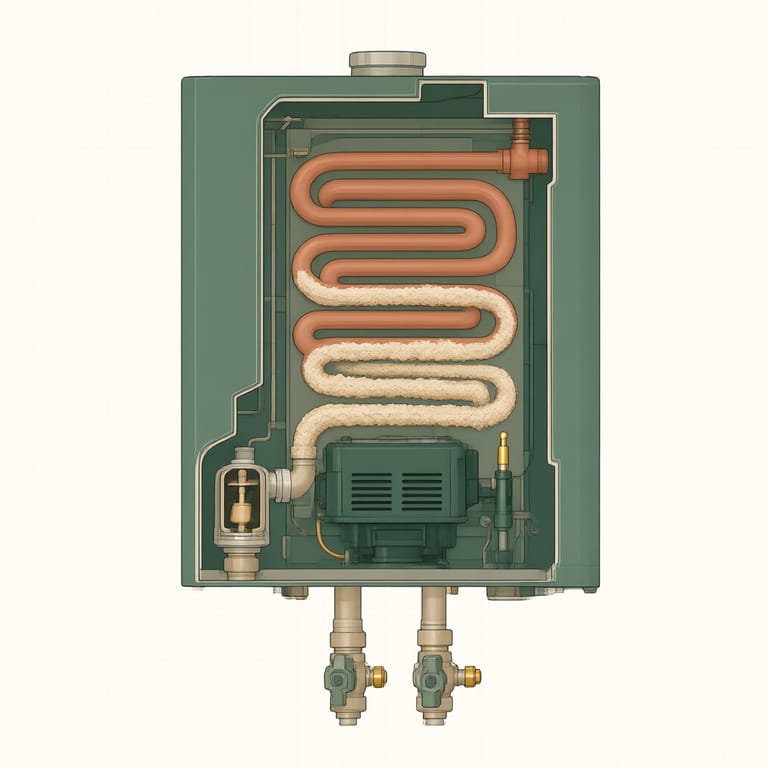
Tankless diagnosis is mostly measurement, and that is what the service fee buys. A technician who knows these units reads the stored error history from the control board, checks gas supply pressure with the burner running (a unit starved for gas throws ignition faults that mimic a bad igniter), inspects the venting and the condensate trap on condensing models, cleans or tests the flame sensor, and pulls the cold inlet screen. If the readings point to scale, the fix is a descaling flush through the service valves; if they point to a component, the part gets swapped and the unit is run at several fixtures at once to confirm a steady temperature rise.
From your side the process has five beats: you describe the symptom and the error code on the phone, the pro diagnoses on site, you get an itemized quote and approve it directly with the installer, the work gets done, and you watch the verification run before anyone leaves. Ask for the old part and the before-and-after readings.
One flush that spares most later repairs
Descaling tops the job list, and nothing buys more protection per dollar. Hard water leaves calcium inside the heat exchanger's narrow passages; the unit compensates at first, efficiency slides, and eventually the sensors read the distortion as a fault and lock out. The DOE's roughly 20-year life expectancy leans on replaceable parts, and industry sources note units in hard-water areas reaching 25 years with regular descaling. If your unit has isolation service valves (many professional installs include them), a tech circulates descaling solution through the exchanger, cleans the inlet screen, and verifies the temperature rise in one scheduled visit. No service valves? Having them added during the first service makes every future flush quick.
Ready to talk to a licensed water heater pro?
Call (800) 555-0184Free call. A licensed local water heater installer picks up.Licensed water heater partners in your area- Licensed and insured partner network
- 24/7 call routing
- Free call, no obligation
- You approve the price with the installer directly
Tankless hot water heater repair prices in 2026
National numbers: water heater repairs run $228-$1,017, with an average around $600, and the full observed range stretches from $90 to $1,775+ (Angi and HomeGuide, 2026 data). What moves a tankless quote inside that band:
- Which part failed. A descale or a flame sensor cleaning sits at the bottom; igniters, fans, and control boards climb toward the middle; a heat exchanger swap dominates the top.
- Warranty status. Many exchangers carry long parts warranties. Check your paperwork before paying for anything, because the part may be covered and only the labor billable.
- Access and valves. Units without isolation valves cost more to flush every time; cramped closets and attic installs add labor.
- Fuel and design. Condensing models add a condensate trap and a second exchanger to check; electric units have no burner or vent and usually cheaper repairs, but 240V work is licensed-pro only.
Set that against replacement: a typical tankless project runs $1,400-$3,900, and complete swaps commonly land at $2,500-$4,500 installed (Angi, 2026). The full breakdown, including the conversion premium, is in our tankless water heater cost guide.
Repair or replace: how to call it by the numbers
- Unit in the first half of its expected life, any single-part failure: repair. One part keeps you inside the DOE's roughly 20-year service window, and the operating-cost math holds: per DOE, households drawing 41 gallons of hot water or less daily run 24-34% more efficiently on demand-type heaters than storage tanks.
- Out-of-warranty heat exchanger on an aging unit: get both quotes. A top-of-band repair against a bottom-of-band replacement is a close race that specific bids should decide.
- Chronic lockouts traced to undersizing or a compromised original install: stop treating symptoms. Price the correction, or read the tankless vs tank comparison before deciding what replaces it.
Three fair objections
"I'm paying a service fee for someone to run vinegar through it." You are paying for the diagnosis that confirmed scale was the problem, the pump and valves to do it without flooding a closet, and the readings that prove it worked. A flush that heads off an exchanger failure is the best money in this guide.
"Days without hot water would wreck us." Tankless work rarely means days: the unit hangs on the wall, nothing has to drain, and most diagnoses and flushes finish in a single visit. If a part has to be ordered, ask the installer for the timeline before you approve the quote.
"There's a descale kit and a video for it." Some manufacturers describe a homeowner flush in the manual. If yours does, the unit has isolation valves, and you follow the manual to the letter, that is a reasonable DIY job. Everything past it (gas components, venting, condensate handling, anything that needs the cover off) is licensed-pro work, for safety and because amateur wrenching can void the warranty that would otherwise pay for the part.
Red flags: call today, not next week
Any one of these means call today:
- An error code that returns after one reset.
- Soot, scorch marks, or melted plastic around the unit or vent connection.
- A CO alarm, or an exhaust smell indoors.
- Water dripping from the case or the exchanger; scale-cracked exchangers leak before they fail outright.
- A breaker that trips on an electric unit, or a gas unit that ignites, runs, and dies in a loop.
For how these systems compare and what they cost to own, start at the tankless hub. Ready for a diagnosis instead of a guess? For tankless hot water heater repair, call (800) 555-0184: a licensed local pro, a real quote, no obligation.