
No Hot Water in the House? Find the Cause Fast
No hot water in the house, but the cold taps run normally? The fault is in the heater, not the supply. Work the checks below in order. Most cold showers trace back to a pilot, a breaker, or a reset button; the rest are a free call to (800) 555-0184, which rings a licensed, insured water heater pro near you at any hour.
No hot water? The first thing to check
- Your nose first. A rotten-egg smell near the tank means you leave the house at once and stay out; dial 911 and then the gas company from outside. Touch no switches, strike no flame, make no calls indoors.
- Rule out a single faucet. Run hot-only at a couple of sinks plus the tub. One cold spot while the others warm up points to that faucet's mixing cartridge, not the tank.
- Name your fuel. Per the US Energy Information Administration, about 48% of US households heat water with natural gas and 46% with electricity. Gas unit: burner door and gas pipe at the bottom, flue on top. Electric: conduit entering the top, no flue.
- Look at the floor. A spreading puddle plus no heat usually means the tank has split: close the cold inlet valve on top, skip the resets, and go to repair versus replace.
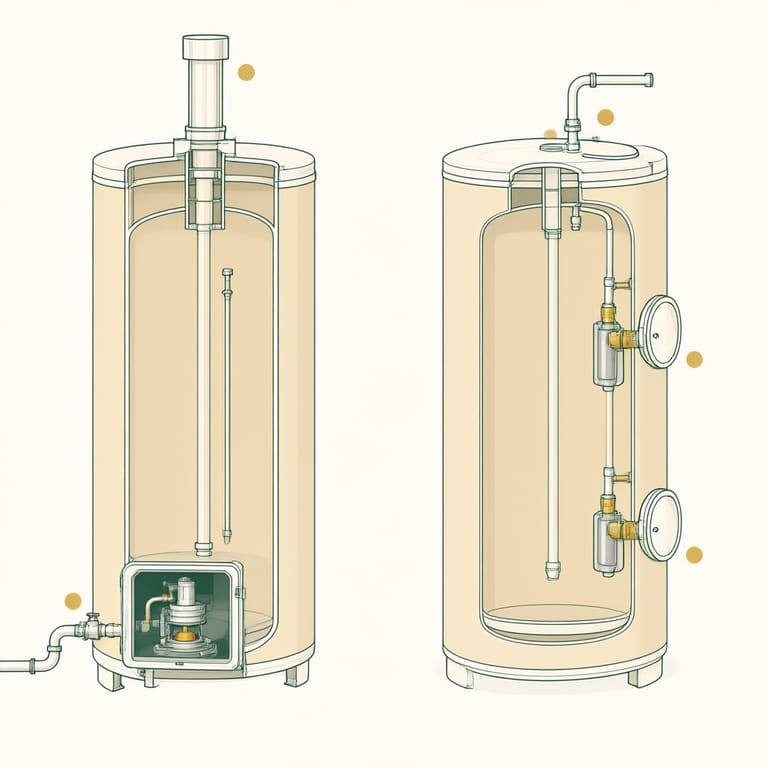
Gas heater: follow the pilot
No gas smell? Look through the sight glass behind the lower access door.
- Pilot is out. Relight it exactly as the tank label says, including its wait for gas to clear, then give the burner time to reheat before judging.
- Flame catches, then goes out once you let go of the knob. Textbook thermocouple failure; that small flame sensor holds the gas valve open and costs little: thermocouple replacement.
- Pilot keeps going out over days or weeks. Draft, a dirty pilot orifice, or a tired gas control valve; the pilot light diagnostic sorts them out.
- Pilot burns but the main burner never fires. Thermostat or gas control valve. Gas-side swaps are licensed-pro work, full stop; see gas control valve replacement.
Electric heater: breaker first, then the red button
- Locate the heater's breaker in the panel. Tripped? Flip it back once only. A second trip means leave it off; a breaker that refuses to stay on is isolating a short.
- Kill the breaker, then press the high-limit reset. The red button sits on the upper thermostat behind the upper access panel, and that wiring carries 240 volts, so power off before the panel comes off. A click tells you the tank overheated (a thermostat stuck closed or a dying element). Power back on, then run a hot tap carefully: CPSC burn tables put a third-degree burn at about 6 seconds in 140F water. Scalding at the tap means breaker off again, and call.
- Reset will not hold, or trips again? A failing element or thermostat is forcing it; that diagnosis is meter work on a live 240V circuit, licensed-pro territory. See heating element replacement and thermostat replacement.
Water heater on but no hot water: what that usually means
Breaker holding or burner lit, yet the taps run cold? Four explanations cover most cases:
- Lukewarm at every tap on an electric tank: it is running on one of its two elements, or the upper thermostat is stuck low.
- Hot for a few minutes, then cold: a cracked dip tube is letting the incoming cold short-circuit to the outlet. See dip tube replacement.
- Cold after back-to-back showers and a laundry load: the tank has not caught up yet.
- Gas burner cycling on and off within a minute: a thermostat or gas valve that no longer reads tank temperature, or sediment insulating the burner from the water.
Call tonight or book tomorrow?
| What you are seeing | The honest verdict |
|---|---|
| Gas smell anywhere near the heater | Leave now; 911 and the gas utility from outside |
| A puddle under the tank that keeps spreading | Call now; shut the cold inlet valve while you wait |
| Breaker trips every time you reset it | Call today, and stop resetting |
| Pilot relit and holding, tank warming up | Solved. Watch it for a week |
| Reset clicked, tank heating again | Morning problem if it holds; repeat trips need a pro |
| Lukewarm at every tap, no leaks, no smells | Book a normal appointment |
Ready to hand it off? (800) 555-0184 puts you through to a licensed and insured water heater partner near you. Embercrest is a publisher, not the crew: partner installers answer 24/7 including weekends, the call is free, and you approve the price directly with the installer, so ask them for the arrival window and any after-hours premium. Expect diagnosis at the tank, a written price before work starts, the fix, and a far fixture running hot as proof.
What the fix should cost
Angi's 2026 national data puts a typical repair between $228 and $1,017, averaging about $600. Per-part ranges from HomeGuide's 2026 figures: a thermocouple is a $20-$30 part, a heating element or thermostat repair runs $100-$350, and a gas control valve lands at $200-$750. After-hours timing, gas-side work, and a leaking tank move the number. Quotes far outside those bands need an explanation; see the water heater repair cost guide.
Repair it, or is the tank retiring?
Storage tanks last 8-12 years (Angi's 2026 planning figure), and a no-heat call on a 10-year-old unit is often the tank announcing retirement. A new tank installs for $881-$1,826 in most cases (Angi, 2026), so a repair near the $600 average on a dying one is rarely the smart spend; run the numbers in the repair-vs-replace guide first.
Three hesitations, answered straight
- "The service call costs more than the part." True for a thermocouple, and an honest pro says so; you pay for diagnosis and proof the tank is safe, only for work you approve.
- "I will be without hot water for days." Common parts are stock items, so ask whether the fix can finish in one visit; the tank still needs time to reheat.
- "I can do this myself." Relighting a pilot and pressing a reset are fair homeowner moves. A live 240V panel, the gas train, or the T&P valve and venting are not.
Quick answers
Why does the whole house suddenly lose hot water?
One component quit, not the whole system: a pilot blown out, a tripped breaker or high-limit switch, a failed thermocouple or element. On an older tank it can be the tank itself; check the floor first.
Hot water heater reset: how do you do it?
Electric: breaker off, upper panel off, press the red high-limit button until it clicks, panel on, breaker on. Gas: relight the pilot per the label. A reset that will not hold is a diagnosis, not a fix.
My cold water is fine, so why is my hot water not working?
Cold water bypasses the heater, so normal cold pressure proves the supply is fine; the fault is in the heater or the hot-side plumbing.
Red flags: stop troubleshooting and call now
- Any gas smell (911 and the utility first, then a pro)
- Water spreading from under the tank
- A breaker or reset that trips again within hours
- Scorch marks, soot, or a sounding CO alarm (that one is a 911 call)
- A tank past 10 years having its first no-heat event
Nothing above matches? The repair library sorts heater problems by symptom. Still no hot water in the house after these checks? Call (800) 555-0184, describe what you tried, and a licensed local pro takes it from there.