
Water Heater Thermostat Replacement: What It Fixes and What It Costs
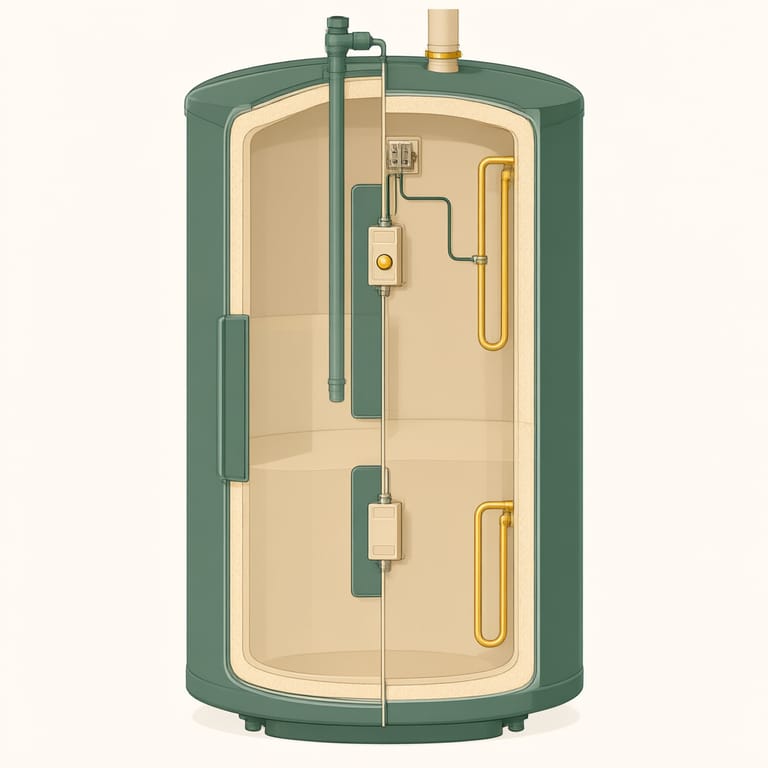
The shower runs scalding on Monday and lukewarm on Tuesday, and the tank is not leaking or running dry. That pattern is the signature of a failing thermostat, and water heater thermostat replacement is one of the cheapest fixes on an electric tank: $100-$350 installed, per HomeGuide's 2026 repair-cost data. Most electric tanks carry two: an upper unit with a built-in high-limit safety switch and a lower unit that does the bulk of the heating. Neither looks like the thermostat on your wall; they are flat switches pressed against the tank steel behind the access panels. When one drifts or dies, the repair is cheap only if it is diagnosed correctly.
Before you call anyone, three quick moves:
- No hot water at all? Check the breaker first; a tripped 240V circuit imitates every part failure on the tank, and the no-hot-water checklist walks you through it.
- Shut the breaker off (these are 240-volt circuits), open the upper access panel, and press the red reset button once without touching any terminals. Close the panel, then restore power. If the button trips again, stop pressing it: the tank is overheating, and that calls for a test, not a thumb.
- Water coming out dangerously hot? Turn the dial down or leave the breaker off until the part is tested, and warn the household.
Rather hand it off? Call (800) 555-0184 and Embercrest connects you with a licensed, insured local pro. Ask for the test before the quote.
Signs you need a replacement thermostat
Thermostat symptoms overlap heavily with heating element failures, which is why a good tech tests both before quoting either. The patterns that lean toward the thermostat:
- Temperature wanders (scalding one hour, tepid the next) while hot-water quantity stays normal. Elements tend to fail dead; thermostats tend to fail erratically.
- The reset button keeps tripping. The high-limit switch on the upper unit cuts power when the tank overheats. A control stuck "on" is a common culprit, and repeated tripping is a warning, not a nuisance.
- The tap runs hotter than the dial says. A drifted sensor under-reports, and the tank quietly runs hot. That costs money too: water heating is about 18% of household energy use per EIA's 2020 Residential Energy Consumption Survey, and CPSC notes the 120°F setting saves energy along with skin.
- One element tests fine but never energizes. The switch that should be feeding it has died open.
A pro confirms it with a continuity test across the contacts, power off.
What water heater thermostat replacement involves
Safety first: these are 240-volt circuits. Every step starts with the breaker off and the circuit verified dead with a voltage tester; that check is the difference between a repair and an emergency-room visit, and it is why the swap itself is licensed-pro work.
From there, a licensed tech works in this order: panels and insulation off; both thermostats and both elements tested; the failed part unclipped from its bracket; the new one seated flush against the tank wall (an air gap makes it misread temperature); wiring transferred terminal by terminal; dial set; panels back on; power restored; outlet temperature checked at a tap once the tank recovers. No draining, because the part sits outside the tank wall, which is why this is one of the faster repairs.
These parts are largely standardized: match upper versus lower (the upper carries the high-limit switch), voltage, and mounting style, not the brand on the tank. A swap on a State Select or GE heater starts with the specs on the old part, not the logo. And a gas heater uses a gas control valve instead, a different and licensed-pro-only job; the repair hub points you to the right guide.
From your side, the visit has three beats. Diagnosis: power verified off, panels open, both heating stages tested; ask which part failed and why. Quote: one price for the swap, a second number if a cooked element turned up, nothing comes off until you approve. Swap and check: one short visit with the tank full, then the dial set where you agreed and the temperature confirmed at a tap.
Where to set the dial afterward: the part most guides skip
Choosing the temperature is a genuine safety decision, not a comfort preference, and two federal agencies pull in opposite directions:
CPSC says 120°F. The Consumer Product Safety Commission urges a 120°F setting, because tap-water scald risk climbs steeply with temperature. Their exposure data for adult skin:
| Water temperature | Time to a third-degree burn (adult skin) |
|---|---|
| 120°F | ~5 minutes |
| 130°F | ~30 seconds |
| 140°F | ~6 seconds |
Children and older adults burn faster still; for them, 120°F at the tap is the number.
OSHA says 140°F in storage. OSHA's Legionella guidance notes that 120°F storage does not kill Legionella bacteria; it recommends storing hot water at 140°F and delivering at least 122°F, since Legionella dies at 140°F in about 32 minutes.
The resolution is plumbing, not picking a side: store hot at 140°F and add thermostatic mixing valves that blend the supply down to 120°F or less at the fixtures. That is the safety-first setup for households with immunocompromised members, worth pricing while the heater is already open.
Ready to talk to a licensed water heater pro?
Call (800) 555-0184Free call. A licensed local water heater installer picks up.Licensed water heater partners in your area- Licensed and insured partner network
- 24/7 call routing
- Free call, no obligation
- You approve the price with the installer directly
How much does it cost to replace the thermostat?
A replacement thermostat for a water heater runs $100 to $350 installed, per HomeGuide's 2026 repair-cost data, against Angi's 2026 figure of $228-$1,017 (average about $600) for water heater repairs overall. What pushes the number around:
- A cooked element. A control stuck on often takes an element with it, turning a one-part ticket into a two-part job.
- Doing both at once. Many pros suggest replacing both thermostats while the panels are open, since the second part is cheap and the labor is already paid.
- The wrong first guess. "Thermostat" sometimes turns out to be a symptom of a failing element instead, which is why testing beats swapping. Service-call minimums and after-hours rates vary by installer.
The repair cost guide breaks down the full menu.
Repair it, or retire the tank?
Almost always repair. The thermostat is one of the cheapest parts on the heater, and the tank is untouched by the failure. Two exceptions: a tank already leaking, where a $100-$350 control is money thrown away and tank-style replacement ($881-$1,826 typical installed per Angi's 2026 data) is the real conversation; and age, because past the 8-12 year industry life expectancy for storage tanks (Angi's planning figure) a repair buys time, not much of it. The repair-or-replace guide runs the math.
Fair questions before you book
"Can't I just replace it myself?" Mechanically it is the easiest swap on the tank: no draining, a couple of screws, and spade terminals. The catch is what sits behind those panels: 240 volts, plus a part that misreads temperature if it is not seated flush. That voltage is why this guide files the job under licensed-pro work.
"Why pay a pro that much for such a small part?" Because the fee buys the test, not the part. A dead element, a tripped high-limit switch, or a loose terminal produce the same symptoms, and a swap that skips the test can leave you with a new thermostat and the same cold shower.
"Will I be without hot water for long?" No. It is typically a single short visit, the tank never drains, and recovery afterward is measured in hours, not days.
When to stop troubleshooting and call
- The reset button trips a second time: the tank is overheating, and the high-limit switch is the last safeguard before the T&P valve.
- The tap runs far hotter than the dial setting.
- A burnt smell, scorched insulation, or discolored wiring at the access panel.
- Moisture inside the access panel or on the floor (see the leaking water heater guide).
- The breaker trips when the heater runs, or hot water is still missing after the breaker and reset have been checked.
Any one of these is a stop sign for DIY. Call (800) 555-0184 and Embercrest connects you with a licensed, insured local installer partner who handles water heater thermostat replacement; ask for both heating stages to be tested before the quote. The call is free; you approve the price with the installer directly.