
Cost of Water Heater Element Replacement in 2026
Most electric tanks make heat with two screw-in elements, an upper and a lower, and when one burns out the fix is among the most routine repair calls a plumber runs. The cost of water heater element replacement in 2026 sits at $100-$350 installed in HomeGuide's national repair data, and the thermostat that works alongside each element prices in the same band. Routine is not the same as predictable: the swap that takes one short visit on a young, accessible tank turns into a sediment excavation on a neglected one, and that is why the band is wide.
Electric water heater element replacement cost in 2026: the price table
Compiled by Embercrest from national repair pricing published by HomeGuide and Angi, checked August 2026. Labor included unless noted; no after-hours premium.
| Job | 2026 range | What sets the price |
|---|---|---|
| Heating element replacement | $100-$350 | Access, sediment, and seized threads |
| Thermostat replacement | $100-$350 | Often tested and swapped in the same visit |
| Water heater repairs overall | $228-$1,017 typical | Average about $600 across all repair types (Angi) |
| New tank water heater, if the math flips | $881-$1,826 installed | Average about $1,346 (Angi) |
The part is a small share of the price; you mostly pay for a licensed pro's time, diagnosis, and drive. And because the same band covers the thermostat, replacing one element and its thermostat in one visit usually lands near the top of the band rather than doubling it; the labor overlaps.
No hot water right now and no appetite for diagnostics? Call (800) 555-0184: Embercrest connects you with a licensed local repair pro for free, and you approve the price directly with the pro.
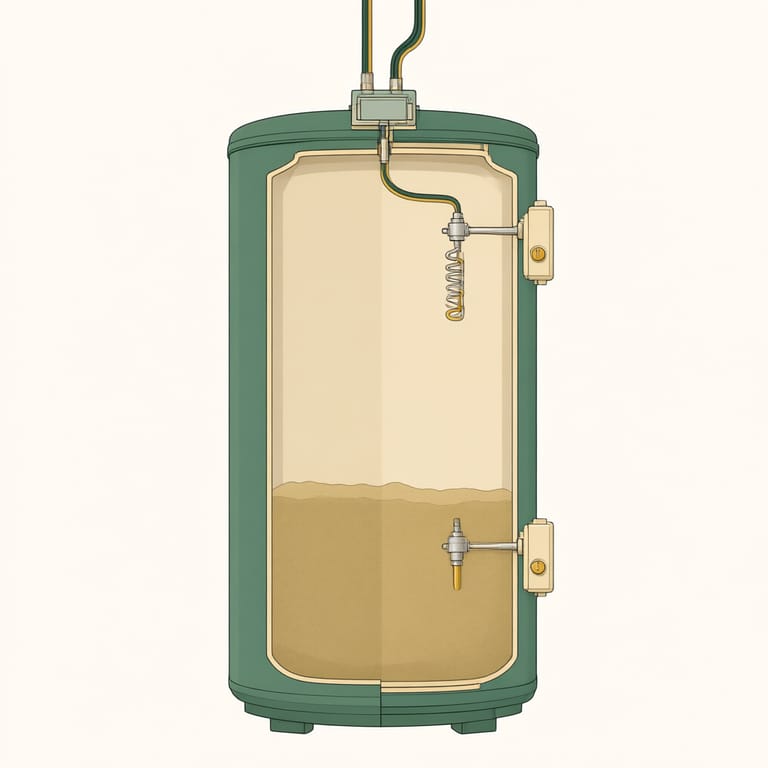
Water heater heating element replacement cost: upper, lower, or both
Which element failed changes the diagnosis more than the price: the two are the same part in two sockets, so the invoice depends on access and condition, not position. What the symptom tells you:
- No hot water at all points at the upper element or its thermostat. The upper one is the tank's manager; if it dies, the lower one never gets the signal to run. Cold-start troubleshooting lives in our no hot water guide.
- Hot water that turns lukewarm fast points at the lower element, which does the bulk heating.
- A breaker that trips repeatedly suggests a shorted element. Replace it and the tripping usually leaves with it, but the pro should confirm the wiring did not cook.
A competent tech tests both elements and both thermostats in minutes with a multimeter. Insist on that test: paying $350 to replace a working part is this job's classic failure mode.
What moves the cost of water heater element replacement from $100 to $350
- Sediment (pushes up). The lower element sits where minerals settle. On a tank never flushed it can be buried in scale: extra drain time, extra fight, sometimes a flush added to the ticket.
- Seized threads (pushes up). Elements screw into the tank and corrode in place over years. A stuck one needs a dedicated socket and leverage, and the minutes add up.
- Access (both directions). A tank in an open garage is the cheap scenario; one boxed into a closet with the panels facing drywall, or sitting in a crawl space, is not.
- A second failed part (pushes up, not double). Elements and thermostats age together. If both need replacing, expect the top of the band.
- Timing (pushes up). After-hours and weekend calls carry a premium at most shops; if you still have some hot water, book the next business day.
Hidden costs the "from $100" ad leaves out
A permit is rarely part of this job: an element swap is a like-for-like repair, not a new installation, and permit rules are built around installations. If a permit line appears, ask what triggered it (our permit guide covers when one is required). The extras that do show up:
- Diagnostic or trip fee. Many shops charge one and credit it toward the repair if you proceed. Ask before booking.
- A flush. If the lower port is buried in scale, draining and flushing the tank becomes a line item.
- Wiring repairs. Scorched terminals, a tired breaker, or aluminum branch wiring turn a plumbing visit into an electrician visit, priced separately.
- Anode rod. Cheap to check while the panels are off; if it is gone, pro replacement runs $150-$350 per HomeGuide's 2026 data (see anode rod replacement cost).
- Haul-away and disposal belong to tank replacement, not a part swap; on this quote they mean something else is being sold.
Why your ZIP code moves the number less than your tank does
Embercrest's ranges are national, and on this job that is unusually honest: the part costs the same everywhere. Geography moves labor (plumbing rates vary by metro, and a high-cost city bills the same hour at a higher rate), and water chemistry moves condition (hard-water regions scale elements faster and seize threads harder, so quotes there cluster toward the top of the band). Climate barely matters.
Ready to talk to a licensed water heater pro?
Call (800) 555-0184Free call. A licensed local water heater installer picks up.Licensed water heater partners in your area- Licensed and insured partner network
- 24/7 call routing
- Free call, no obligation
- You approve the price with the installer directly
Why elements fail, and what the failure cost you before the repair
Two killers dominate. Scale coats the element, forces it to run hotter and longer for the same water, and eventually cracks the sheath. Dry fire destroys one instantly: power applied while the tank is not full, usually right after a drain or a new install, burns out the exposed coil in seconds. Any pro refilling a tank keeps the breaker off until water flows from a hot tap; if you drain your own tank, that rule is yours too.
There is a money angle to scale. Electricity averaged 18.44 cents per kilowatt-hour for US homes as of May 2026, per the US Energy Information Administration, and EIA's residential energy survey puts water heating at about 18% of household energy use. A scaled-up element spends more of those cents per gallon of hot water for months before it fails; the repair bill is just the visible end of a cost that started earlier.
DIY or pro: the 240-volt line comes first
The repair is mechanically simple, and none of that matters if the circuit is live. Residential electric water heaters run on 240 volts, a shock hazard that can kill an adult, so anything behind the access panels (terminals, thermostats, the elements themselves) is licensed-pro work. What is safely yours: reading the symptoms, noting the wattage and voltage on the rating plate, buying the matched part, and keeping the breaker off until the tank is full again after any drain. Whoever opens the panels follows the same rules: breaker off first; verify dead at the terminals with a tester, not by assumption; and if anything at the panel or wiring looks scorched, melted, or improvised, stop and hand the job to an electrician.
Still set on doing it yourself? The part is inexpensive and the service guide walks through how pros do the swap. Price your risk honestly: against a $100-$350 professional bill, the money you save is modest and the voltage is not. Stop and call a pro the moment:
- the breaker trips again right after the new part goes in (a wiring or thermostat fault is still there);
- the old part will not break loose with the right socket and firm pressure (forcing it can crack the tank fitting);
- water leaks from the port after the swap and a new gasket;
- you see scorch marks, melted insulation, aluminum branch wiring, or a double-tapped breaker anywhere in the circuit (electrician work, not plumbing).
Replacement kit or bare element: what "replacement" should mean
Not all elements are equal. Screw-in types dominate modern tanks; older units may take flange-mounted ones. Some homeowners call the part a coil; electric water heater coil replacement is the same job under another name. The spec that matters is wattage and voltage, printed on the old part and on the tank's rating plate: a higher-wattage unit than the circuit was sized for turns a cheap repair into an electrical problem. Low-watt-density designs spread the same wattage over more surface area, so they run cooler and scale slower; in hard water, asking for one is the cheapest upgrade available during a repair that is happening anyway.
Shopping the part yourself? For an electric water heater the part usually ships as a replacement kit: the element bundled with a new gasket and sometimes the socket wrench. The gasket matters most: reusing a compressed old one is the classic source of the slow leak that shows up a week later.
Whoever has the panels off should also check the thermostat setting. The CPSC recommends 120°F: at 140°F tap water can inflict a third-degree burn in about 6 seconds, versus roughly 5 minutes at 120°F. One caveat: 120°F storage does not kill Legionella. OSHA's guidance is to store hot water at 140°F; a tempering (mixing) valve at the fixtures then keeps tap water scald-safe, the usual answer for at-risk households. Raise that trade-off with the tech if it applies to your home.
Repairing the element vs. a new tank: the five-minute replace test
Before authorizing even the cheapest element swap, run the age check. A tank at 8-12 years, the standard planning life for storage water heaters in Angi's 2026 guidance, with rust-tinted hot water, seam streaks, or a prior leak is telling you where the story goes. Money spent on parts there is money not spent on the replacement that is coming anyway; a new tank water heater runs $881-$1,826 installed in Angi's 2026 national data. A young tank with one dead element, by contrast, is the best-case repair in this niche: cheap part, clean fix, years of remaining life.
One more date belongs in the math. DOE's new residential standards take effect May 6, 2029, and from then on electric storage units over 35 gallons must use heat pump technology. A standard electric resistance tank bought today is the last of its generation. That cuts both ways: a mid-band element swap keeps a mid-life tank running until you choose the next one; an end-of-life tank is a reason to start that conversation now rather than feed it parts. The 50% rule and per-part prices are in our repair cost guide.
Quick answers on hot water heater element replacement cost
Is it worth paying the cost of water heater element replacement on a 10-year-old tank?
Only if the tank is otherwise sound: no rust in the hot water, no seam weeping, no prior leaks. At that age a $100-$350 repair buys time, not a new life, so run the 50% rule and ask the pro what they saw while the panels were off.
Should both elements be replaced at the same time?
If one died of scale and age, the other has lived the same life, and swapping it while the panels are already off adds a part and a few minutes, not a second trip. If a dry fire killed the upper one on a young tank, the lower one is fine. Ask what the meter said.
How do I get a price for my tank instead of a national range?
Call (800) 555-0184. Embercrest connects you with a licensed local repair pro near you, free, and the pro quotes your tank after testing it; you approve the price directly with them. Every other water heater price on the site starts at the cost hub.
Ready to talk to a licensed water heater pro?
Call (800) 555-0184Free call. A licensed local water heater installer picks up.Licensed water heater partners in your area- Licensed and insured partner network
- 24/7 call routing
- Free call, no obligation
- You approve the price with the installer directly