
50 Gallon Electric Water Heater Replacement Cost in 2026
Two numbers should drive this decision: what installers charge today, and a federal deadline that changes what you will be allowed to buy next time. The typical 50 gallon electric water heater replacement cost in 2026 is $881-$1,826 installed for a like-for-like swap, with the national average near $1,346, per Angi's 2026 cost data. The 50-gallon resistance tank is the workhorse of American hot water: manufacturer sizing charts point households of three or four at it, and 46% of US homes heat water with electricity, according to the US Energy Information Administration. The units are commodity-priced; the interesting decisions sit around the tank.
50 gallon electric water heater replacement cost: the 2026 price table
National 2026 data from Angi and HomeGuide, checked August 2026; installed figures, with permits, disposal, and code extras as separate lines (below).
| Option | 2026 installed price | Notes |
|---|---|---|
| Tank replacement, typical | $881-$1,826 | National average about $1,346 (Angi) |
| Full range across tank sizes | $600-$2,500 | Size drives price; 50 gallons sits above the small-tank floor |
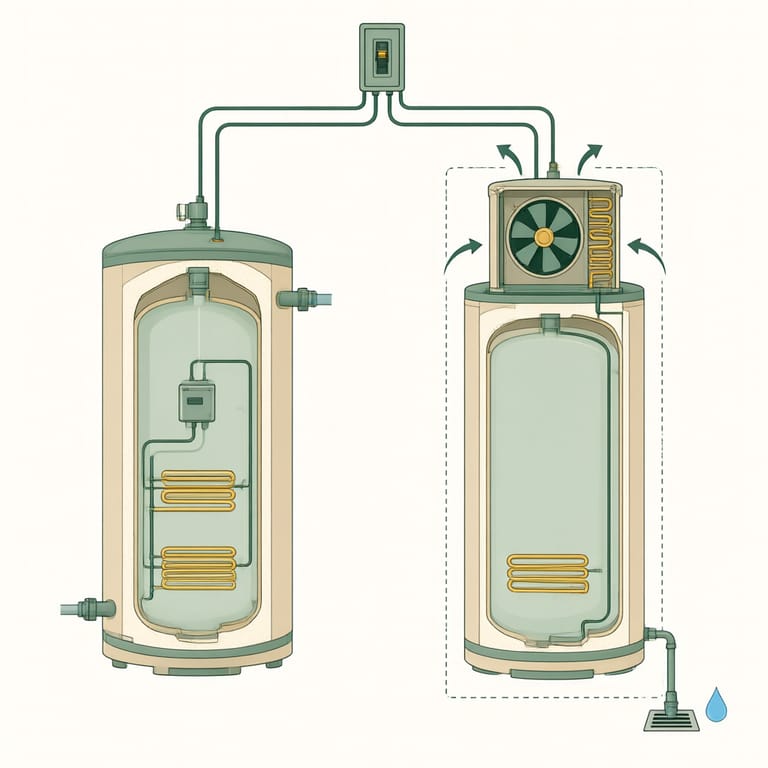
| Heat pump (hybrid) alternative | $3,200-$4,700 typical | Average about $4,200; observed $2,800-$8,000 (Angi) |
| Element or thermostat repair instead | $100-$350 | HomeGuide per-part range; worth pricing first on tanks under 8 years old |
For a quote on your actual closet, garage, or basement, call (800) 555-0184: free call, licensed local installer, price approved directly with the pro.
What pushes a 50-gallon swap up or down the band
A like-for-like swap in an accessible spot (garage or basement, floor drain, working shutoff, wiring that passes) prices near the middle of the typical range. You drift toward $1,826, or past it, when the job stops being a swap:
- Relocating the tank. New water runs, a new circuit, sometimes a new drain path: the biggest single jump, because a simple swap turns into a small remodel.
- Access. Attic platforms, crawl spaces, and tight closets add carry time, and sometimes force a lowboy or slim tank that costs more per gallon.
- A corroded or seized shutoff valve that has to be replaced before the new tank goes in.
- Wiring that will not pass. Undersized or scorched conductors, a missing disconnect, a breaker that does not match the element rating. That becomes an electrician's line item, and 240-volt work is licensed work.
Brand and warranty tier matter far less than the job around the unit; the installation and labor cost guide dissects that spread line by line.
Hidden costs: the lines under the unit price
Headline numbers leave these out; a good quote itemizes them:
- Permit and inspection. Most US jurisdictions treat swapping a water heater as permitted work, with fees set locally; check your city's or county's schedule, and see the water heater permits guide for what the inspector looks for.
- Code extras. A drain pan and drain line above finished space, an expansion tank on a closed plumbing system, a T&P discharge pipe routed to code, seismic strapping where local rules require it. Each is a modest part plus labor, and they stack. Electric tanks skip one extra gas owners pay for: there is no vent to correct.
- Haul-away, disposal, and timing. Disposal of the old tank is billed separately by some installers, and a same-day or after-hours call can carry a premium; ask before the installer is dispatched.
40, 50, or 80 gallons: how tank size moves the price
40 gallon electric water heater replacement cost. Within the $600-$2,500 size-driven range that Angi reports, a 40-gallon electric swap prices below a comparable 50-gallon job, and manufacturer sizing charts match it to one to three people with ordinary habits. If your current 40 never runs cold, replacing like for like beats upsizing on reflex: a bigger tank costs more to buy and more to keep hot.
Replacement cost for an 80 gallon water heater. An 80-gallon unit means a bigger vessel, more floor load, and a price near the top of the full range, usually justified by large households or soaker tubs. Before you go there, check the first-hour rating on the yellow EnergyGuide label (hot water delivered in a busy hour); a faster-recovering 50-gallon model often solves the shortage for less.
Replacing a 50 gallon gas water heater. If the house has gas service, the same size in a gas tank is a separate budget with venting and combustion-air rules attached; the gas tank replacement page covers that job. Smell gas near the tank and the script is fixed: everyone out first, no switches, phones, or lighters on the way, then 911 and the gas utility from the yard.
Condo water heater replacement cost. Condos and apartments carry their own cost gravity: the tank usually lives in an interior closet above finished space, so expect a code-required drain pan and drain line, tighter haul-in logistics, and HOA insurance paperwork. Same unit price, more labor and liability around it: quotes land in the upper half of the typical band, and a leak on the eighth floor is a multi-unit event, so do not skip the pan.
May 6, 2029: the rule that changes the replacement after this one
Buy a 50-gallon resistance tank in 2026 and you are buying the last of its line. Under the Department of Energy's finalized residential standards, from May 6, 2029 onward any electric storage model above 35 gallons must be built around a heat pump. Your existing tank is untouched; the rule bites when it wears out and its successor is a heat pump at a very different price. Two defensible plays: cheap resistance tank now, pocket the gap; or heat pump today, start banking the savings.
Ready to talk to a licensed water heater pro?
Call (800) 555-0184Free call. A licensed local water heater installer picks up.Licensed water heater partners in your area- Licensed and insured partner network
- 24/7 call routing
- Free call, no obligation
- You approve the price with the installer directly
Resistance vs heat pump: the numbers side by side
| Parameter | Standard electric (resistance) | Heat pump (hybrid) |
|---|---|---|
| Installed cost, 2026 | $881-$1,826 | $3,200-$4,700 typical |
| Efficiency (UEF) | About 0.9-0.95 | 3.3-4.1 for ENERGY STAR certified models |
| Planning lifespan | 8-12 years | 10-15 years |
| Annual savings estimate | Baseline | About $550 a year for a family of four, per ENERGY STAR |
| Install needs | Existing 240V circuit | Condensate drain, clearance and air volume, 240V circuit |
The efficiency row carries the argument. Heat pump models certified by ENERGY STAR carry UEF ratings of 3.3-4.1, so each kilowatt-hour buys three to four times the hot water a resistance element does, and the program's math puts a four-person household's saving near $550 a year and past $5,600 over the unit's life. With the EIA's May 2026 average at 18.44 cents per kWh (17.37 a year before), resistance heating ranks among the costlier ways to make hot water, and roughly 18% of a home's energy goes to hot water. The heat pump water heater installation guide covers the install itself.
Scenario verdicts. Family of four, staying 10+ years, utility room with a drain: the heat pump premium pays back, so get quotes on both. Tight budget, tank died this morning: the resistance swap is cheap, proven, and legal to buy for years yet. Cramped closet with no drain path: resistance again, because heat pump units need air volume and condensate handling. For switching fuels, see gas vs electric.
Why your local quote will not match the national band
Angi's $881-$1,826 is a national band; your ZIP code lands inside or outside it for reasons unrelated to the tank. Labor rates set most of the spread. Permit fees are municipal: a rounding error in one county, a real line item in the next. Code extras cluster by region (seismic strapping in earthquake country, expansion tanks where closed systems are the norm, pans over finished floors). Electricity prices matter more for the heat pump decision than for the swap; the EIA figure above is a US average, so use your own bill for the payback math. Get two itemized local quotes and compare them line by line against the table above.
Rebates in 2026: check before you count
The federal Section 25C credit, once worth 30% of a heat pump water heater project up to $2,000, ended for equipment put into service after December 31, 2025, per the IRS. A 2026 quote dangling "30% back from the IRS" is repeating last year's news. What survives: state-run HEAR rebates and utility programs, both tied to where you live and what you earn. Confirm current terms with the state energy office or utility before a rebate shrinks your budget number.
Set it to 120°F, with one asterisk
Whichever tank wins, the dial setting is a safety call first. The Consumer Product Safety Commission says 120°F, for a reason: tap water at 140°F causes a third-degree burn in roughly 6 seconds, while at 120°F a person has about 5 minutes before the same injury, the margin that protects kids and older adults. The asterisk: Legionella bacteria survive 120°F storage. Where that risk runs higher, OSHA's guidance is a 140°F tank delivering no less than 122°F at the outlets; households square the two by keeping the tank hot and blending down at the fixtures with thermostatic mixing valves. If anyone at home is immunocompromised, ask the installer directly.
DIY vs pro on a 50-gallon resistance tank
No gas line makes this the least dangerous water heater to replace yourself, which is not the same as safe. You still have to move a bulky tank, make the water connections, verify a 240-volt circuit dead at the breaker and at the terminals, and in most cities pull a permit either way. The saving is the labor share of the quote; the risk is a flooded floor, an electrical fault, and a warranty that assumes a code-compliant install. Anything beyond reconnecting the existing, correctly sized circuit is licensed electrical work.
Call a licensed pro instead if any of these show up:
- wiring that looks scorched or undersized, or a breaker that already trips on the old unit;
- no shutoff valve that actually shuts;
- a T&P discharge pipe routed wrong, capped, or missing;
- a spot where a leak would flood finished space;
- a closed plumbing system (check valve or pressure-reducing valve on the main) with no expansion tank.
The electric tank replacement service guide covers what a by-the-book install includes; the DIY guide to replacing a water heater walks the honest boundary step by step.
Questions about replacing a 50-gallon tank
How long does a 50-gallon electric tank last?
Budget for 8-12 years, the planning figure Angi and manufacturers work from. Tanks that reach the upper end usually got a fresh anode rod every 3-5 years and a yearly sediment flush.
Is repairing cheaper than replacing?
For a young tank, usually. A heating element or thermostat runs $100-$350 installed (HomeGuide 2026 data), and a typical water heater repair lands at $228-$1,017, around $600 on average, per Angi. Under 8 years old with a dry floor: repair first. Over 10 years, or leaking from the vessel itself: replacement wins. The repair cost guide and the repair vs replace page run that math.
That band is the 50 gallon electric water heater replacement cost on paper. The number for your house comes from a local quote: call (800) 555-0184 and Embercrest connects you with licensed, insured local installers, free, with the final price approved between you and the pro. Compare every option at our cost hub.
Ready to talk to a licensed water heater pro?
Call (800) 555-0184Free call. A licensed local water heater installer picks up.Licensed water heater partners in your area- Licensed and insured partner network
- 24/7 call routing
- Free call, no obligation
- You approve the price with the installer directly