
Gas Hot Water Heater Replacement: Cost, Safety, and the Licensed-Only Line
Roughly half of US homes heat water with gas: natural gas serves about 48% of households, per the US Energy Information Administration. This page covers a natural gas hot water heater replacement and its propane cousin: what it costs in 2026, where the licensed-only line sits, and how the day goes.
Safety comes before anything else here. If you smell gas (the rotten-egg odorant), leave the building immediately, then call 911 and your gas utility from outside or from a neighbor's. Do not flip switches, light flames, or use phones indoors, and never hunt for the leak yourself. A quote can wait; this cannot. Symptoms and what the utility does are in our gas leak guide.
No smell, just a dead tank? Call (800) 555-0184: Embercrest connects you with a licensed, insured local installer, free, and you approve the price directly with the pro.
Is the tank actually done? Repair or replace, symptom by symptom
These tanks fail in ways that look identical from the doorway but price out very differently:
- Pilot will not stay lit. Often a thermocouple (part about $20-$30) or, less happily, a gas control valve at $200-$750 to replace (HomeGuide 2026): repairs, not replacements, on a tank with years left.
- Rusty or metallic-tasting hot water. Corrosion inside the tank. Early in the tank's 8-12 year planning life (Angi 2026), an anode rod swap may arrest it; near the end of that window, it is the opening act of a leak.
- Water on the floor from the tank body itself. Terminal. No part fixes a corroded-through tank; this is the one symptom that means replacement, full stop.
A national water heater repair runs $228-$1,017 (average about $600, Angi 2026). The usual rule: a repair bill near half the cost of a new unit, on a tank in the back half of that 8-12 year window, means replace; under that line, on a sound tank, fix the part. The repair vs replace guide runs the math; the main replacement page covers what applies to every fuel.
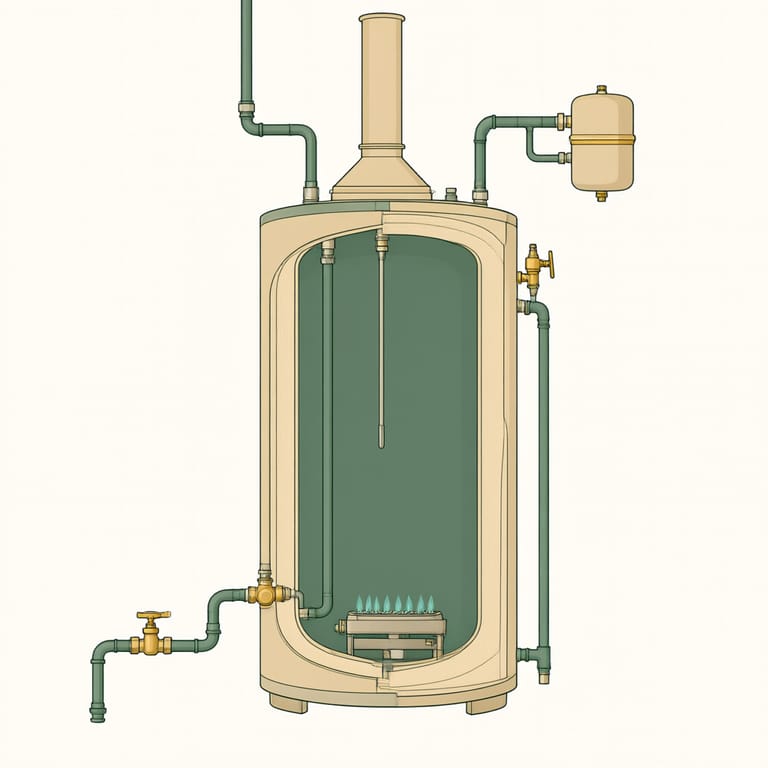
Natural gas water heater replacement: what a compliant swap involves
A like-for-like swap of a 40- or 50-gallon atmospheric tank is routine work, but three zones are licensed-only nearly everywhere, which is why this is not a how-to:
- The fuel connection. New connector, new shutoff if the old one is suspect, and a sediment trap (drip leg) ahead of the control valve; every joint leak-tested with solution or a manometer, never a match.
- Venting and draft. Flue diameter, slope, clearances, and draft at the hood, checked end to end; a backdrafting unit pushes carbon monoxide into the living space.
- Combustion air. A tank boxed into a tight closet since the original install may need louvers or ducted air so the burner does not starve.
Then the parts the installer handles on every fuel: water connections, a drain pan and seismic strapping where code requires them, and a T&P relief valve with a full-diameter discharge pipe, ending in view, never capped (capped discharges have caused tank explosions, per ICC water heater safety guidance). None of this is gatekeeping: a gas mistake can put carbon monoxide in a bedroom.
The job from your side of the hallway
- The call. Have the label capacity, the fuel (natural gas or propane), and the unit's location ready; that is enough for a ballpark and a slot when a stocked unit fits.
- The quote. Written and itemized before any work: unit, labor, venting or fuel-line corrections, permit, haul-away.
- The swap. Fuel off at the appliance valve, water off, tank drained and out. New one set level, connections made in the order above, pilot lit, burner cycled.
- Sign-off. Draft verified at the hood, T&P valve tested, thermostat set to 120F per CPSC scald guidance (CPSC's exposure table: a third-degree burn in about 6 seconds at 140F). Immunocompromised household? Ask about hotter storage plus a mixing valve at the fixtures, since 120F storage does not kill Legionella (OSHA). Then the permit inspection.
Ready for step one? Call (800) 555-0184 to reach a licensed, insured partner installer who prices the job.
What gas hot water heater replacement costs in 2026, and what moves the number
A like-for-like tank replacement lands in the national $881-$1,826 installed range (average about $1,346, Angi 2026); Angi's full range runs $600-$2,500, with tank size the main driver. Gas jobs also carry line items an electric swap never sees:
| Quote line | Why it appears on gas jobs |
|---|---|
| Venting corrections | Flue size, slope, or clearances that passed decades ago often fail today; bad draft puts exhaust in the house |
| Sediment trap / drip leg | A short capped stub on the gas line that catches debris before the control valve; cheap, code-required, often missing |
| Flexible connector and shutoff | Aged fittings are not reused on a new fuel connection |
| Permit and inspection | Fuel-fired appliance swaps are permitted work almost everywhere; see who pulls it and why |
If a quote is one round number, ask for this breakdown; an installer who resists itemizing is telling you something. Fuel-neutral labor and permit costs: replacement cost guide.
Ready to talk to a licensed water heater pro?
Call (800) 555-0184Free call. A licensed local water heater installer picks up.Licensed water heater partners in your area- Licensed and insured partner network
- 24/7 call routing
- Free call, no obligation
- You approve the price with the installer directly
40 gallon water heater or 50? Picking the replacement size
The common residential sizes are 40 and 50 gallons, and like-for-like is the default because venting, clearances, and connections already fit. Move up if the household grew or the old tank ran out during back-to-back showers; stay put if the closet is tight, since a bigger tank costs more to buy and run. The installer reads the first-hour rating on the EnergyGuide label, not just the gallons: a 40-gallon tank with faster recovery can match a slower 50.
Same fuel, or is this the moment to switch?
Like-for-like is the cheapest, fastest path, but replacement is also when switching costs are lowest:
- Staying on gas keeps operating costs predictable: residential natural gas averaged $15.34 per thousand cubic feet in 2024, roughly $1.48 a therm, per EIA data. DOE standards effective May 6, 2029 push electric storage tanks over 35 gallons to heat pump technology and make only minor updates for gas-fired storage, so a gas tank bought today is not the one facing a mandate.
- Switching to electric or a heat pump unit changes the math on install cost and monthly bills; the full comparison is at gas vs electric.
Three honest hesitations
- "It costs more than my neighbor's electric quote." Often true, because of the venting, sediment trap, and permit lines above; those separate a safe install from a cheap one.
- "I do not want a day without hot water and a mess." A stocked like-for-like swap is commonly finished in one visit, and the drain-down and pan make the mess a bucket, not a flood.
- "I could do it myself for the price of the tank." The tank-wrestling, yes. The fuel connection, venting, and combustion-air check are where DIY stops in most jurisdictions, and where insurers get unfriendly about unpermitted work; the DIY replacement page lists which tasks are yours.
Questions owners ask before they call
Does replacement work the same way on a propane water heater?
Yes: same steps, same licensed-only zones. The differences are an LP-rated unit (or a conversion kit, where the manufacturer offers one, fitted by the pro), the regulator, and a supply tank that may sit outside. Never run a natural gas unit on propane without that conversion.
Does the old venting carry over?
Only if it passes inspection at today's code, not the code of the year it was installed. This is a common budget surprise on these swaps.
Is a permit really required for a same-size swap?
In most places, yes; fuel-connected appliances are exactly what permitting exists for. The installer should include and handle it. Here is what the inspector checks.
How fast can it happen if I have no hot water?
With a stocked unit, a like-for-like swap is usually the quickest job on an installer's board; venting corrections or odd sizes slow it.
Do gas tanks last longer than electric ones?
Planning data does not separate them: 8-12 years either way (industry planning figure, Angi 2026). What differs is failure mode: burner, thermocouple, and venting issues join the corrosion clock both types share.
When to stop reading and call
- Water on the floor from the tank body, not from a fitting.
- A pilot that will not stay lit after a new thermocouple.
- Soot, scorch marks, or a lazy yellow flame at the burner: incomplete combustion; treat it as a carbon monoxide risk and stop using the unit.
- Rusty hot water on a tank in the back half of its 8-12 year life.
- Any gas smell: that is the 911-and-utility protocol at the top of this page, not a service call.
For everything else on that list, (800) 555-0184 is the shortcut to a licensed, insured installer who handles gas hot water heater replacement in your area, permit on the quote, price approved by you before work starts.
Ready to talk to a licensed water heater pro?
Call (800) 555-0184Free call. A licensed local water heater installer picks up.Licensed water heater partners in your area- Licensed and insured partner network
- 24/7 call routing
- Free call, no obligation
- You approve the price with the installer directly