
Water Heater Pressure Relief Valve Replacement: Shut It Down First
The T&P valve (temperature and pressure relief, also written TPR) is the last safety device on a tank. A drip is a message; a steady discharge is an order. Either way, never plug it. Below: what to do in the next five minutes, how to tell an emergency from a morning appointment, and what water heater pressure relief valve replacement should cost once a licensed pro takes over.
If the relief valve is discharging hot water or steam right now:
- Kill the heat. Gas model: twist the control knob near the tank base to OFF. Electric: switch off the breaker at the panel.
- Close the cold-water inlet. Find the shutoff on the supply line at the heater's top. A wheel handle closes clockwise as far as it goes; a lever handle is closed when perpendicular to the pipe.
- Open a hot tap at any sink and leave it running. That bleeds off pressure and temperature.
- Stay clear of the discharge pipe. What comes out can be close to tank temperature: per CPSC scald data, 140F water causes a third-degree burn in about six seconds. Send children and animals elsewhere.
- Do not cap, plug, or wire the T&P shut, not even "just for tonight." A blocked relief valve turns a water heater into a pressure vessel with no way out; the International Code Council documents water heater explosions caused by exactly this move.
- Smell gas at any moment? Everyone walks out right away. Once outdoors, dial 911, then the gas utility's emergency line. Inside, touch no switches, strike no flame, make no calls.
Heater shut down and stable? Get a licensed pro moving: (800) 555-0184. Embercrest is an independent publisher; the call connects you with a licensed, insured local water heater partner who picks up around the clock, weekends included. The call costs nothing, you agree the price with the installer directly, and the arrival window comes from them on the call, not from this page.
Emergency, or a Tuesday-morning appointment?
Handle it now if any of these is true:
- Steady flow or steam from the discharge pipe, or the valve "blowing off" with force
- The discharge pipe is hot along its whole length and will not cool
- There is no discharge pipe at all, just bare threads pointing at the room
- Water is also seeping from the tank body (a different failure; see water heater leaking)
- The tank rumbles or pops while it discharges (overheating; compare water heater making noise)
Book a normal visit if the valve releases a cup or two after heavy hot-water use, then stops. That pattern is usually thermal expansion in a closed plumbing system: annoying, fixable, not an explosion in progress. Still a real problem, because a seat that weeps regularly crusts with minerals and may seize open or shut.
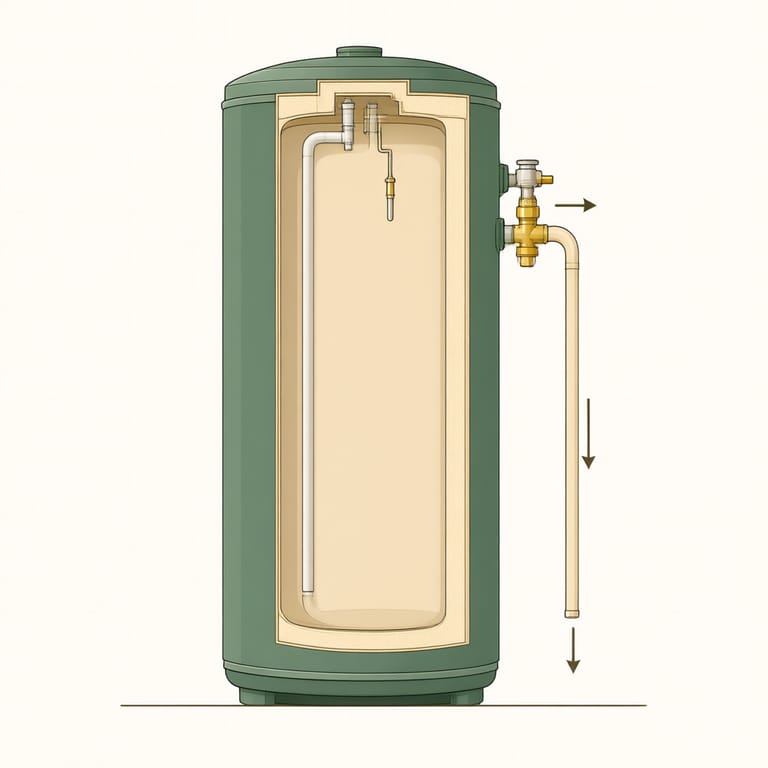
What the discharge pattern is telling you
| Pattern | Most likely cause | Urgency |
|---|---|---|
| Occasional short discharge after showers or laundry | Thermal expansion: pressure spikes with nowhere to go | Schedule soon; the fix is often an expansion tank, not just a new part |
| Continuous drip regardless of usage | Worn or fouled seat, or chronic high supply pressure | Days, not weeks: swap the part and test supply pressure |
| Forceful discharge, steam, rumbling tank | Overheating from a failed control or thermostat | Now: shut down per the steps above and call |
| Never tested, crusted with scale | Age; it may not open when it must | Replace proactively; a stuck-shut valve is the silent version of this emergency |
While you wait for the pro
- Put a bucket under the discharge pipe and mop standing water. A wet floor is tonight's slip hazard and next month's mold.
- Leave the cold inlet closed and the heat off until the pro says otherwise.
- Do not drain the tank yourself unless the pro on the phone asks you to; a mis-sequenced drain on a hot tank adds scald risk for no benefit.
- Photograph the valve, the discharge pipe, and the pressure gauge if you have one. It makes the phone quote sharper.
Can a pressure relief valve be changed on a hot water heater?
Yes, and on a standard gas or electric tank it is one of the more contained repairs: replacement means threading out the old valve, threading in a new one with matching ratings, and proving the system is safe afterward. The licensed installer's visit, from your side of the basement:
- Heat off, cold inlet closed, a hot tap open (already done).
- A few gallons drained from the fitting at the base, until the water level sits below the relief port (on the side of most tanks, on top of some).
- Discharge pipe off, old part out, new valve threaded in with sealant. Its temperature and pressure ratings and relief capacity must match the tank's data plate; the tag on the old one shows the numbers.
- Discharge pipe rebuilt to code. Per ICC guidance on IRC P2804.6.1: full outlet diameter, an air gap, no direct drain connection, ending where you can see it, at the floor, a pan, or outdoors.
- Tank refilled with the hot tap open until it runs steady, then heat restored. On gas that means the relight sequence from the label plus a check that the vent connector on top was not knocked loose, since a displaced vent can spill carbon monoxide indoors. Then a lever test: a clean burst through the pipe and a dry reseat. A static pressure reading at a hose bib shows whether high supply pressure or a closed system caused the discharge.
Electric and gas tanks share the same swap; only the shutdown and restart differ. Tankless water heaters carry a relief valve too, usually on the hot-side isolation kit, and replacement there follows the manufacturer's spec with the same no-cap rule. Between the scald risk, the rating match, and the code work on the pipe, this job sits on the licensed-pro side of the line.
Ready to talk to a licensed water heater pro?
Call (800) 555-0184Free call. A licensed local water heater installer picks up.Licensed water heater partners in your area- Licensed and insured partner network
- 24/7 call routing
- Free call, no obligation
- You approve the price with the installer directly
What water heater pressure relief valve replacement costs
The part itself is inexpensive; you are paying for diagnosis, drain-down, correct installation, a code-legal discharge pipe, and pressure verification. Nationally, water heater repairs run $228-$1,017 with an average around $600 (Angi, 2026 data), and a straightforward swap sits at the low end of that band. HomeGuide's 2026 per-part data puts small fixes at $100-$350 and gas control valve or complex leak jobs at $200-$750. What pushes the bill up:
- After-hours timing. Night and weekend dispatch usually carries a premium; get it quoted on the phone before anyone drives.
- The valve was not the disease. If thermal expansion or high street pressure caused the discharge, the honest fix adds an expansion tank or pressure-reducing work.
- Code catch-up. A missing or illegal discharge pipe gets corrected during the visit.
Full repair pricing context: water heater repair costs.
Replace the valve, or the whole heater?
A T&P is never repaired, only replaced. The bigger question is whether the tank around it is worth the visit. Keep the heater when the tank body is dry, the discharge has a clear cause, and the unit is inside the 8-12 year planning life Angi cites for storage tanks. Price a new heater as well when the tank body is weeping, the unit is past that window, or the bill climbs toward half the cost of a replacement ($881-$1,826 installed for a standard tank, Angi 2026 data). The decision framework lives in repair vs replace.
Thirty seconds on the phone that sharpen the quote
- Gas or electric, and the capacity printed on the tank's label
- What the valve is doing right now: drip, steady stream, or full discharge, and whether the heater is already shut down
- Whether a discharge pipe exists and where it ends (floor, pan, outside, nowhere)
- Any history: prior drips, recent plumbing work, a new water meter, backflow preventer, or pressure regulator on the street side
That last item matters most: a newly closed system is the usual backstory, and the honest fix is an expansion tank, not a third valve.
After the fix: one habit, and when to call again
Test the T&P regularly (InterNACHI's guidance is monthly): lift the lever briefly, confirm a burst of water through the discharge pipe, let it snap back. Set the thermostat with both numbers in mind: CPSC recommends a 120F water heater setting to limit scalds, while OSHA notes that 120F storage does not kill Legionella and calls for 140F storage with delivery at 122F or more. The usual way to square the two is a thermostatic mixing valve at the fixtures; settle that trade-off with the pro.
Call again, not later, if the new valve drips within days (a pressure problem the swap did not solve), if the discharge comes back hot and forceful (a control or thermostat failure), or if the tank body starts to weep. Valve behaving but the tank still misbehaving? Start at the repair hub to narrow it down, or call (800) 555-0184 for a licensed local pro who handles water heater pressure relief valve replacement and can check supply pressure and expansion in the same visit.