
Water Heater Replacement Parts: Match the Symptom Before You Buy
Strip away the sheet metal and a storage water heater is a dozen replaceable parts (rods, elements, valves, thermostats, a dip tube) wrapped around the one part that is not: a steel tank that rusts through cannot be repaired at any price. Knowing which side of that line your problem sits on is worth real money. Angi's 2026 data puts the typical repair at $228-$1,017 (average about $600) against $881-$1,826 for a new installed tank. This page sorts replacement parts for a water heater by symptom, with what each repair costs and a link to each fix's guide.
Three hard rules before any diagnosis. If you smell gas anywhere near the heater, leave the building immediately, then call 911 and your gas utility from outside. Do not flip switches, light flames, or use phones indoors. Parts shopping waits. On electric units, everything behind the access panels runs on 240 volts: breaker off and the circuit verified dead with a tester, or hands off. Anything that opens a gas connection, changes the venting, or touches the temperature and pressure relief (TPR) valve piping is licensed-professional work.
Replacement water heater parts: the full table
Which set of parts you own depends on fuel. The U.S. Energy Information Administration counts roughly 48% of U.S. homes heating water with natural gas and 46% with electricity, and the two designs share about half their parts list. Prices are national 2026 figures from HomeGuide, pro-installed unless the row says part only.
| Part | Found on | What it does | Telltale failure sign | Typical pro repair |
|---|---|---|---|---|
| Anode rod | Gas + electric | Corrodes sacrificially so the tank does not | Rotten-egg smell or rust tint in hot water only | $150-$350 |
| Heating elements | Electric | Upper and lower resistance heaters | No hot water (upper) or fast-fading hot water (lower) | $100-$350 |
| Thermostats | Electric | Switch the elements at the set temperature | Erratic temperature; reset button trips | $100-$350 |
| Thermocouple | Gas | Proves the pilot is lit before gas flows | Pilot lights, then will not stay lit | Part only $20-$30, plus the service call |
| Gas control valve | Gas | Meters gas to the burner and pilot | No ignition, erratic burner, error codes | $200-$750 |
| Dip tube | Gas + electric | Routes cold inlet water to the tank bottom | Lukewarm taps; plastic flecks in aerators | Small-repair band, $100-$350 |
| TPR valve | Gas + electric | Relieves dangerous temperature and pressure | Dripping or discharging from its pipe | Small-repair band; never ignore, never cap |
| Drain valve | Gas + electric | Empties the tank for service | Weeping, or will not close after a flush | Small-repair band |
Drain valve swaps are covered in the flush guide; every row above is indexed from the repair hub.
Replacement parts for a gas water heater
The gas-side extras all live at the burner: a thermocouple (or a thermopile on units with electronic gas controls) that proves the pilot is lit, the gas control valve, the pilot assembly and igniter, the burner, and on newer sealed-combustion designs a gasketed burner door with a flame-arrestor screen that must stay clean. The gas valve, burner, and venting sit on the combustion side, where a mistake means a gas leak or carbon monoxide, so that work belongs to a licensed pro.
Replacement parts for an electric water heater
Electric heaters trade the burner for two heating elements, each paired with a thermostat, plus a high-limit reset button on the upper thermostat. Elements are specified by voltage, wattage, and mount style, thermostats by upper or lower position, and both are standardized. Set a new thermostat at 120F, the CPSC's scald-prevention recommendation (140F water causes a third-degree burn in about 6 seconds); OSHA notes that 120F storage does not kill Legionella, so households with immunocompromised members should ask the installer about 140F storage with mixing valves at the taps.
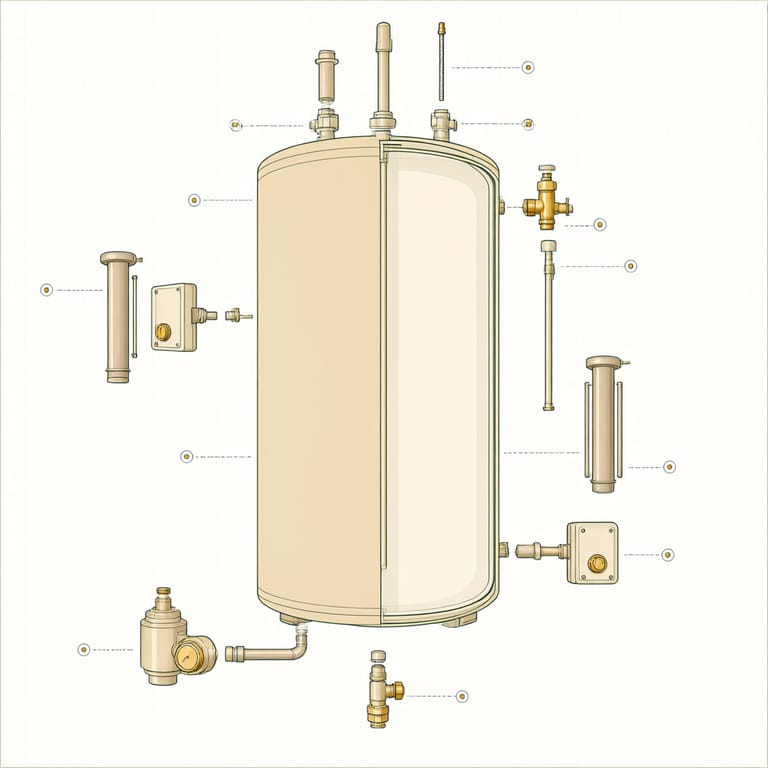
Start from the symptom, not the parts counter
No hot water at all. Electric: breaker first, then the upper element and thermostat. The upper element runs first, so its death takes everything down. Gas: if the pilot will not stay lit, the thermocouple is the classic culprit; no ignition at all points to the gas control valve.
Hot water that fades fast or never gets hot. Three suspects, in order of likelihood: a dead lower element (electric), a broken dip tube dumping cold water into the hot layer, or a tank bottom full of sediment. Plastic flecks in your faucet screens settle it in the dip tube's favor.
Smelly or discolored hot water, cold taps fine. That is the anode rod telling you it is spent. Swap it before the corrosion moves to the tank wall.
Water where it should not be. A drip from the TPR valve's discharge pipe is a pressure symptom, not a nuisance. The International Code Council's water heater safety guidance (iccsafe.org) is blunt that a TPR discharge line must stay unobstructed and never be capped; capped TPR valves have caused water heater explosions. A weeping drain valve is a cheap fix. Water seeping from the tank body itself is the one failure on this page with no part to buy.
Popping, rumbling, crackling. Sediment on the tank floor: a flush, not a part, and a reason to check the anode while the tank is drained.
Ready to talk to a licensed water heater pro?
Call (800) 555-0184Free call. A licensed local water heater installer picks up.Licensed water heater partners in your area- Licensed and insured partner network
- 24/7 call routing
- Free call, no obligation
- You approve the price with the installer directly
Water heater parts replacement: what you can do yourself, and where to stop
Most replacement parts for a water heater fall on one side of a single line. On the owner's side, with basic tools: flushing the tank and swapping a weeping drain valve, checking or replacing the anode rod (a seized rod may need a breaker bar), replacing a dip tube once the tank is drained and the cold inlet nipple is out, and swapping a thermocouple on an open, accessible burner. Heating elements are the borderline case: breaker off, circuit proven dead with a tester, tank cooled before draining, or it is not an owner job.
On the pro's side, on every heater: gas control valves, burners, sealed pilot assemblies, venting, the TPR valve and its discharge pipe, thermostat swaps (240 volts at the terminals, as the thermostat guide explains), and any wiring you cannot positively de-energize. The failure modes there are gas, carbon monoxide, electrocution, scalding, and tank rupture rather than a wet floor.
When the answer is not a part
The tank is the boundary of repair economics. Steel weeping through rust at a seam or under the insulation means replacement, whatever the table says. Short of a leak, use the 50% rule: when a repair quote crosses half the cost of a new installed tank (roughly $670 against Angi's 2026 average of $1,346), put the money toward replacement, especially past the industry's 8-12 year tank life. Stacked repairs count too: a gas valve this year after an anode rod last year is a tank talking about retirement.
Electric owners have one more date to weigh. DOE residential standards effective May 6, 2029 require new electric storage heaters over 35 gallons to use heat pump technology. A standard resistance tank bought today is therefore the last of its kind: an argument for repairing a sound one, and for replacing a tired one with a heat pump unit.
Stop diagnosing and call now if: gas smell (protocol above, from outside the building), scorch marks or melted wiring at any panel, a TPR valve discharging repeatedly, water pooling under the tank, or a breaker that re-trips immediately. Those are past parts shopping. Call (800) 555-0184 and Embercrest connects you with a licensed, insured local pro; the call is free, and you approve any work directly with the installer.
Buying replacement parts for a water heater without getting burned
Take the make, model, and serial number from the data plate on the tank; parts match the plate, not the brand's marketing name. Standardized parts (elements, thermostats, universal thermocouples, TPR valves) come from a plumbing supply counter or a big-box store, while gas control valves and pilot assemblies are model-specific and worth ordering through the manufacturer's parts line.
One honest caveat before any order: on a tank near the end of its run, the smartest replacement part is sometimes the whole appliance, and the repair-vs-replace guide runs that math. If the symptom tree above did not settle it, a licensed pro can test the parts in place before you buy anything: call (800) 555-0184 and Embercrest connects you with one near you.