
Water Heater Anode Rod Replacement, by the Numbers
An anode rod costs $20-$50 as a part. The steel tank it protects costs $881-$1,826 to replace (about $1,346 on average, per Angi's 2026 installation data). This page covers water heater anode rod replacement: the schedule, the installed price, what a pro visit looks like, and when the money should go to a new tank instead. Already sure the tank is worth saving? Call (800) 555-0184; Embercrest connects you with a licensed, insured local installer who quotes the part and the tank side by side.
What the sacrificial anode is sacrificing itself for
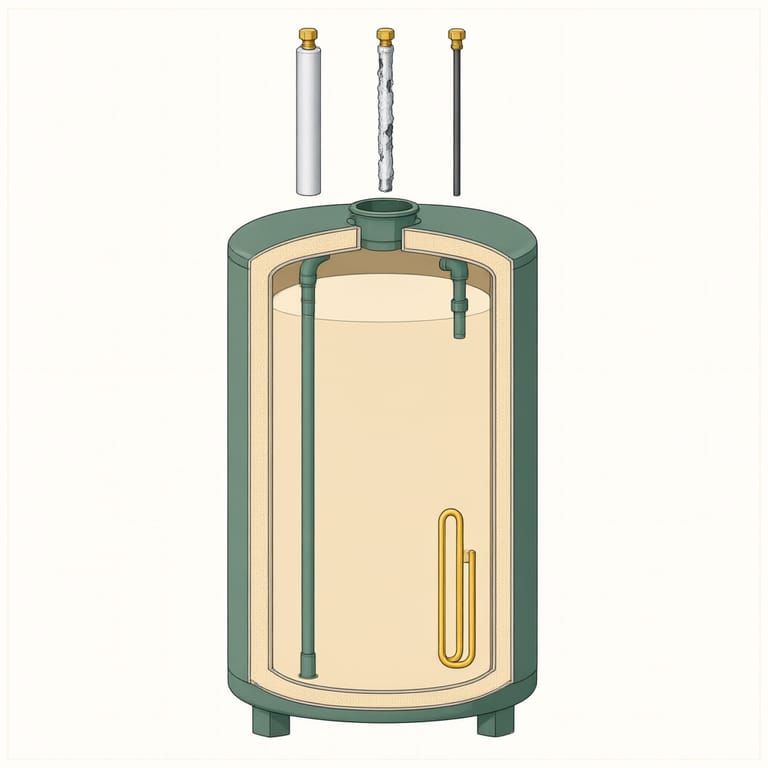
Under the glass lining of a storage tank sits plain steel, and that lining always has pinholes the hot water eventually reaches. The sacrificial anode, a magnesium or aluminum core cast around a steel wire, is built to corrode more readily than the tank wall, so the chemistry goes after it and leaves the steel alone: the rod is consumed in the tank's place. Eaten back to bare wire, it stops protecting, and rust gets a start on the one component of a heater nobody can repair. A rusted-through tank is a replacement, full stop, which makes sacrificial anode replacement the best-paying maintenance a storage heater gets. Heating water takes roughly 18% of a household's energy, per the U.S. Energy Information Administration; the appliance running up that bill has earned a $30 part every few years.
Before anyone touches the tank: safety
Sulfur smell vs. gas smell. A rotten-egg odor that comes out of the hot tap and nowhere else points to the anode and the bacteria that feed on it, not a fuel leak. Gas you smell in the room is a different emergency: get everyone out of the house at once, and only from outside call 911 and the gas company; on the way out, touch no light switch, strike no flame, and leave phones alone until you are clear of the building.
Power and fuel off. Electric tank: breaker off before the cap is touched; anything past that breaker (the elements run on 240V) belongs to a licensed pro. Gas tank: control to pilot or vacation, and the vent pipe and draft hood up top are not to be bumped, since a vent knocked out of place can dump carbon monoxide into the living space; gas piping and venting stay pro work.
Hot water is hot. Whatever drains out is at thermostat temperature, and the CPSC puts a third-degree burn at roughly six seconds of contact with 140F water, so the hose goes to a floor drain or out a door, clear of feet and pets.
Six signs the rod is spent or overdue
- Rotten-egg smell from hot taps only. A spent or reacting anode hands hydrogen to sulfur-loving bacteria inside the tank; cold taps smell fine, hot taps stink.
- Rust-tinted hot water. Clear on the cold side, yellow or brown on the hot: the steel has begun to corrode.
- Popping or rumbling. Sediment piled on the bottom traps pockets of steam that crack as they break free; our water heater noise guide tells those sounds apart.
- Gray paste in faucet aerators. Aluminum anodes near the end shed a jelly-like residue that ends up in fixture screens.
- A water softener in the house. Softened water eats rods quicker; read every interval at its short end.
- Five-plus years with no inspection. If no one has ever pulled the cap, the odds say it is due.
The 3-to-5-year rhythm
The same 2026 Angi data that puts tank life at 8-12 years treats anode replacement every 3-5 years as the habit that carries a tank to the upper end of that span. The easy moment to look is the annual tank flush, while the heater is already drained and cooling off. Hard water, softened water, and a hot thermostat all shorten the interval. Half gone, or core wire showing? Swap it.
What water heater anode rod replacement involves
Cold inlet valve closed, breaker off or gas control on pilot, a few gallons let out so the level sits below the port. Off comes the plastic cap, the oversized hex head is cracked loose with a breaker bar or an impact gun, the spent rod is drawn up and out, and the fresh one threads in over sealant. Refill with a hot tap open to bleed air before power returns (an electric element fired in air burns out in moments), then leak check. Under a low ceiling, a segmented rod feeds in one link at a time; a combo rod doubles as the hot-water outlet fitting.
The wild card is a seized rod: years of heat cycles and mineral buildup can weld the hex head to the tank, and muscling it on an aging tank is how a $30 job becomes a leak at the fitting.
Which replacement anode rod for a water heater?
Magnesium gives the strongest protection in most supplies and is the default pick. Aluminum, often alloyed with zinc, outlasts it in hard water and usually clears a rotten-egg smell because it releases less hydrogen. A powered (impressed-current) anode does not get used up; it needs an outlet within reach and costs more going in, but it ends the 3-5-year cycle, which suits softened water that chews through standard magnesium. Length and thread have to match the tank; read them off the spec plate or the maker's parts list.
Ready to talk to a licensed water heater pro?
Call (800) 555-0184Free call. A licensed local water heater installer picks up.Licensed water heater partners in your area- Licensed and insured partner network
- 24/7 call routing
- Free call, no obligation
- You approve the price with the installer directly
How the service call plays out
- Your call. You describe the symptom and the tank's age; the installer tells you whether it sounds like a $300 job or a new tank.
- Tank check first. Before the cap comes off, the tech reads the age from the serial plate and looks over fittings and pan for rust and moisture. Well into its second decade? Put the money toward a new one; the repair hub covers that decision.
- The quote. Two figures, anode versus tank; whichever you choose, you approve it with the installer directly.
- Work and check. Drain-down, swap, refill, leak check, and the thermostat returned to where it was (the CPSC's scald-prevention figure is 120F; households that store hotter to suppress Legionella temper it with mixing valves at the fixtures). Hot taps are out only for the visit, and you leave with a date for the next look.
What it costs in 2026
| Option | Typical price | What it buys |
|---|---|---|
| DIY, part only | $20-$50 | The part; you supply socket, wrench, and afternoon |
| Professional replacement | $150-$350 | Inspection, removal, new anode, leak check (HomeGuide, 2026) |
| New tank, installed | $881-$1,826 | What you are postponing (Angi, 2026; average about $1,346) |
What pushes the price around: a hex head that fights back, tight clearance (segmented anode), a powered unit, and pairing the swap with a flush. The line items are broken out in our anode rod cost guide.
New anode or new tank: the repair-vs-replace math
The working rule: once a repair reaches half the price of a new unit, stop repairing. Angi's 2026 figures put the average repair near $600 and a new tank near $1,346, so a $150-$350 anode swap sails under that line on a younger tank. Price is not the deciding factor, though; age and evidence are. A tank beyond the 8-12 year window already sending rusty hot water or showing moisture at its base will not be rescued by a fresh rod; an anode heads off corrosion and cannot undo it. The whole decision tree lives in our repair-or-replace guide, and the replacement service page handles what a new tank involves.
The honest objections, answered
"$300 for a rod I could buy for $30?" Fair point. With a cold shutoff that holds, an impact wrench in the garage, and a hex head that cooperates, this is a reasonable job to do yourself. The pro fee buys leverage on a stuck fitting, plus somebody else's liability if that fitting gives.
"Won't it make a mess?" A few gallons run through a hose to a drain; hot water is back the same day.
"My tank is 11 years old, so why bother?" You may well be right. A fresh anode cannot un-rust a tank, and beyond the 8-12 year window the arithmetic generally favors replacing it. Get eyes on the tank before you decide.
When to put the wrench down and call a pro
- A firm pull does not budge the hex head, or the whole tank rocks when you lean on the wrench.
- Rusty hot water a flush will not clear, or rust or dampness around the tank base or in the pan.
- A cold shutoff that does not hold, or a drain valve that refuses to close again.
- The T&P relief valve on the tank's side keeps weeping once the tank is full again.
- A tank at 10 years or older whose rod has never been looked at.
Want the rod-or-tank question settled by someone who can see the heater? Call (800) 555-0184; Embercrest connects you with a licensed local installer who prices both, and you approve the figure directly. Done on schedule, water heater anode rod replacement is the cheapest way to buy your tank a few more years.